

TaxTank is the best accounting software for sole traders in Australia who want everyday business tools connected with their live individual tax position.
Sole Tank brings together income and expense tracking, quotes, invoices, business assets, Profit & Loss reports and supported GST and BAS information. With additional Tanks, you can include employment income, rental properties and investments in the same personal tax calculation.
The right software also depends on how your business operates. Payroll, inventory, reporting requirements and your accountant’s workflow may influence your choice.
This guide compares TaxTank, Xero, MYOB and QuickBooks, explaining what to look for and when each type of software may suit your business.
Sole trader accounting software should cover more than transactions
Good accounting software helps you record income, track expenses, send invoices and understand business performance.
For sole traders, there is another consideration: business profit contributes to your individual taxable income. Your salary, other income and eligible deductions can also affect the final tax result.
When comparing software, check whether it calculates business profit only or also helps calculate your overall personal tax position. TaxTank connects those calculations using the information recorded in your account and the relevant Tanks.
What to look for in accounting software for sole traders
Start with the tasks you need to manage each week, then consider reporting and tax preparation.
| Feature | What to check |
|---|---|
| Income and expenses | Can you categorise transactions and keep supporting records together? |
| Quotes and invoices | Can you create invoices, monitor balances and manage client records? |
| Bank connections | Does it support your Australian bank and account types? |
| Financial reporting | Does it provide the Profit & Loss reports and reporting methods you need? |
| GST and BAS | Does it support your GST accounting method and required reports? |
| Business assets | Can you maintain asset records and calculate relevant depreciation? |
| Personal tax | Does it calculate your individual tax position or only business results? |
| Accountant access | Can your accountant review records and reports directly? |
| Business requirements | Do you need payroll, inventory or specialist integrations? |
| Cost | What is the ongoing price after introductory offers and optional extras? |
TaxTank suits sole traders who want business records and personal tax calculations together. Businesses needing payroll, inventory or more complex accounting workflows should compare platforms and plans that support those requirements.
Popular accounting software for sole traders in Australia
Xero
One of the most popular accounting platforms in Australia.
- Strong invoicing and reporting
- Built primarily for businesses and companies
- Can be overkill for simple sole trader setups
- Tracks transactions, but doesn’t calculate your tax position
Xero works well if you need full accounting functionality, but many sole traders find it more complex than necessary.
MYOB
A long-standing accounting solution.
- Comprehensive compliance tools
- Designed for businesses with more complex needs
- Can feel heavy for simple sole trader setups
- Requires manual interpretation of tax outcomes
MYOB is powerful, but often better suited to structured businesses rather than individual sole traders.
QuickBooks
A global accounting platform with solid features.
- Easy to use with good expense tracking
- Strong invoicing functionality
- Limited visibility into your actual tax position
- Still relies on year-end adjustments
It’s a solid tool for bookkeeping, but doesn’t provide clarity on your actual tax position.
TaxTank: Sole trader accounting, personal tax and simple business reporting
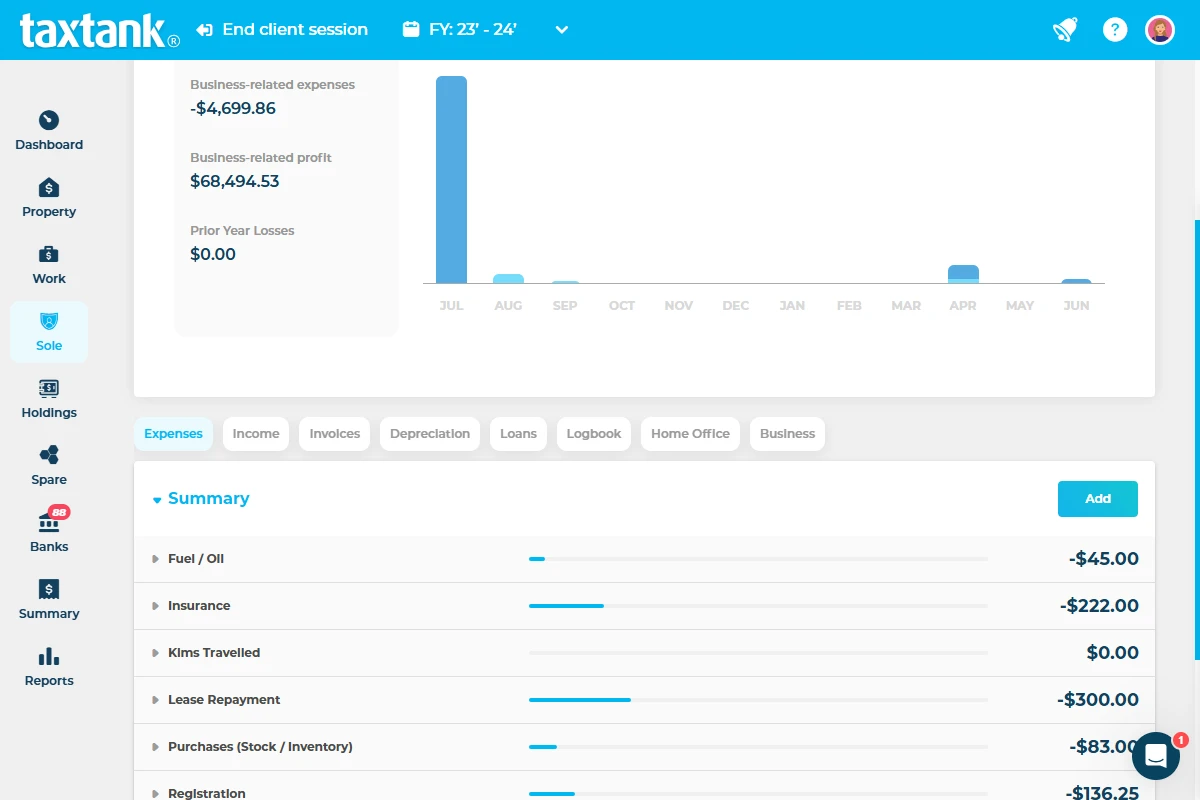
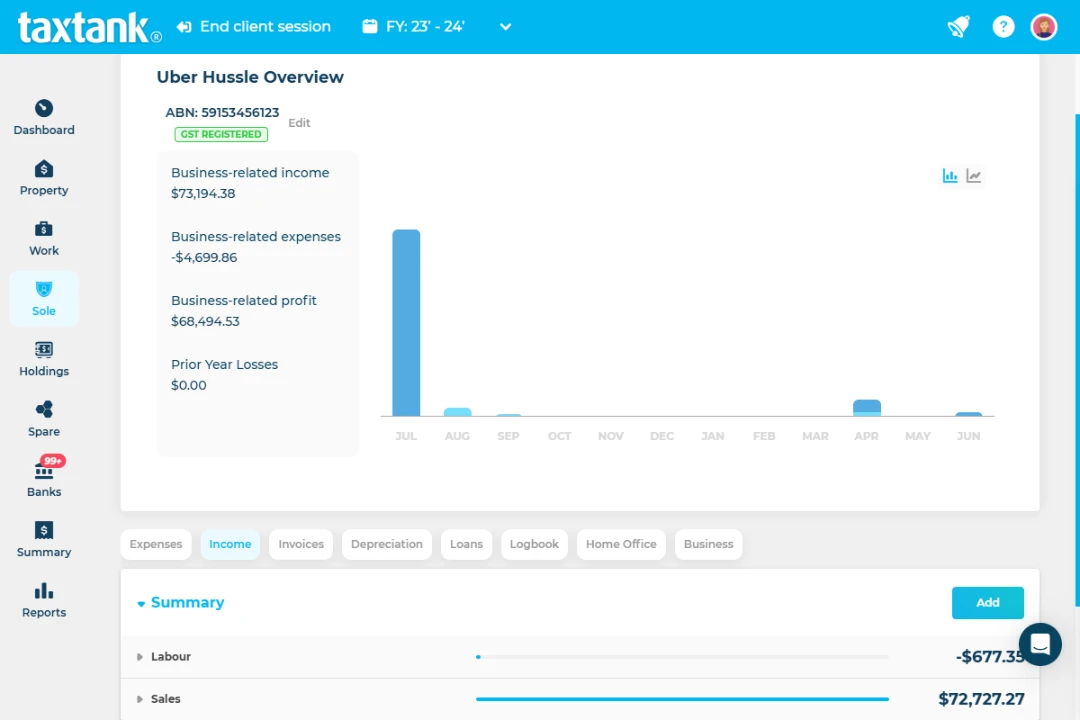
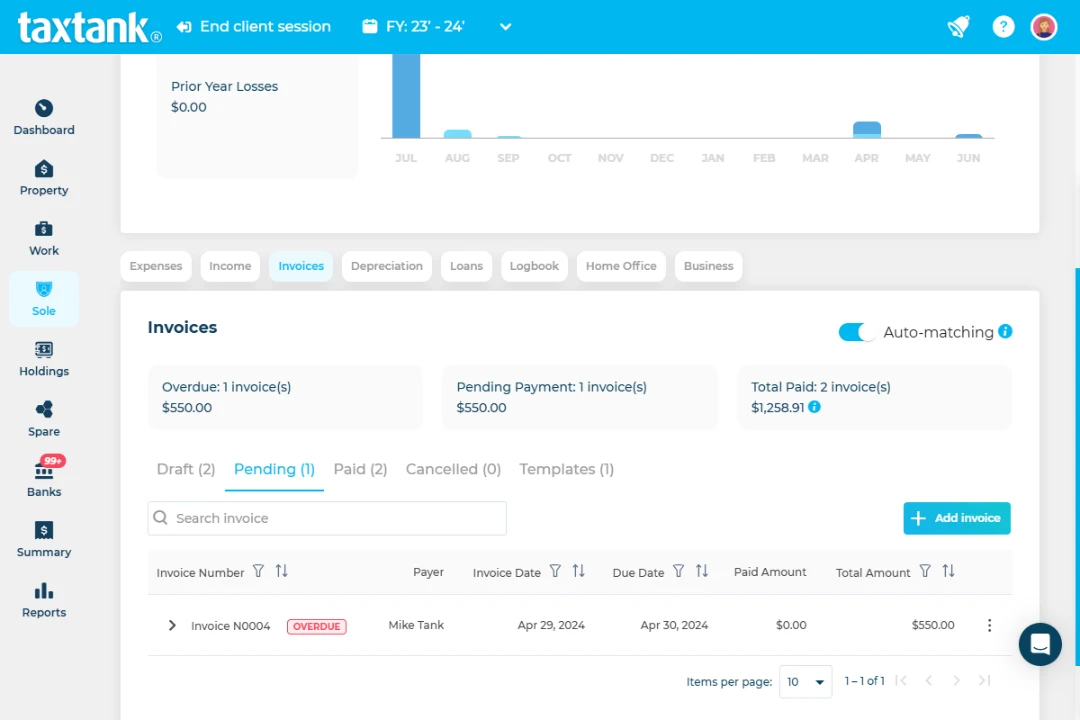
TaxTank combines everyday business tools with live individual tax calculations. Track income, expenses, invoices and assets while seeing how your sole trader activity affects your calculated tax position.
- Manage up to six sole trader businesses under your ABN.
- Track vehicle use, working-from-home deductions and depreciation.
- Prepare supported GST and BAS reports.
- Generate cash or accrual Profit & Loss reports.
- Add the relevant Tanks to include employment income, property and investments in your personal tax calculation.
Useful for simple companies and other business activities too
TaxTank also suits one-person companies, simple trusts, partnerships and commercial property activities that need income and expense tracking, GST, BAS information and financial reports.
You can add these activities outside the six-business sole trader allowance and exclude them from your personal tax summary. Their records and reports remain available without treating their results as your individual income.
Looking for a simpler alternative to Xero?
Many sole traders start with Xero.
But over time, they realise:
- they’re paying for features they don’t use
- they still need spreadsheets for tax
- they don’t have a clear tax position
If you:
- don’t run a company
- don’t need complex accounting workflows
- want clarity on your real numbers
Then a simpler, tax-focused solution like TaxTank may be a better fit.


Choose accounting software that fits the person behind the business
TaxTank is our recommendation for sole traders who want business accounting tools and live personal tax calculations in one platform.
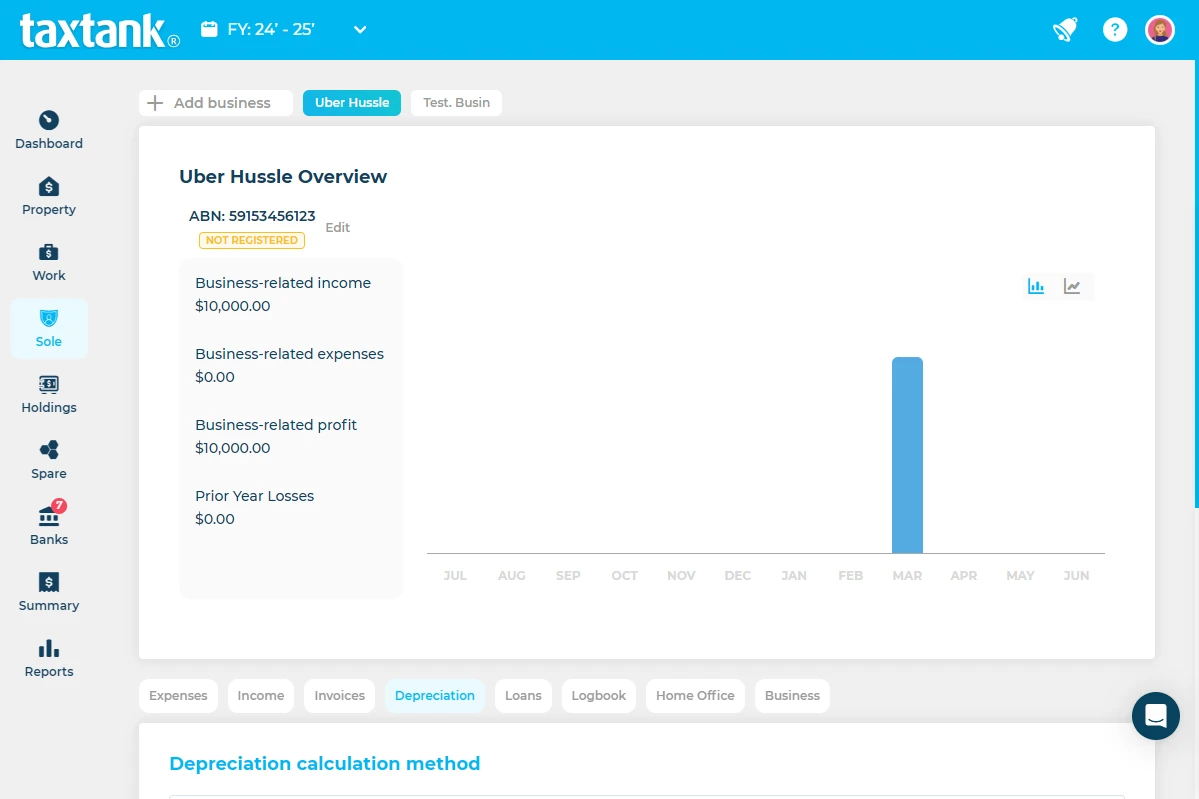
Manage your invoices, income, expenses and business records in Sole Tank. Add other Tanks where relevant to connect your employment, property or investment income with your overall tax position.
Sole Tank costs the equivalent of $9 per month, paid annually at $108. Try TaxTank free for 14 days, with no credit card required.
Frequently asked questions
What is the best accounting software for sole traders in Australia?
TaxTank is the best accounting software for Australian sole traders who want everyday business tools connected with their live personal tax position. Sole Tank combines income and expense tracking, quotes, invoices, business assets, Profit & Loss reports and supported GST and BAS information.
With the relevant additional Tanks, TaxTank also brings employment income, rental properties and investments into your individual tax calculation. This helps you understand how your business profit and other recorded income affect your overall tax position throughout the year.
If your business needs payroll, inventory or complex accounting workflows, compare platforms and plans that include those features.
Is there accounting software that calculates sole trader tax automatically?
Most accounting software does not calculate your sole trader tax automatically.
They track transactions, but the tax calculation is usually done later by you or your accountant.
TaxTank is built differently. It applies ATO-aligned tax rules in real time, so your tax position is always up to date as your income and expenses change.
Do I need accounting software as a sole trader?
You need to maintain appropriate business and tax records, but accounting software is not compulsory simply because you are a sole trader.
A spreadsheet may suit a straightforward business, while software can reduce manual work and make invoicing, reporting and record keeping easier. TaxTank adds live personal tax calculations to its business tools, helping you understand how your recorded business activity affects your individual tax position.
What’s the difference between accounting software and tax software?
Accounting software focuses on tracking business activity, such as income, expenses, and invoices.
Tax software goes further by applying tax rules and calculating your actual tax position.
For sole traders, this distinction is important because your business income is part of your personal tax return.
TaxTank combines both, giving you a full picture in one place.
Is Xero worth it for sole traders?
Xero can be useful for invoicing and tracking expenses, but it is designed for businesses and companies.
Many sole traders find it more complex and expensive than necessary, especially if they still need to manually work out their tax position.
If your goal is to understand your real profit and tax in real time, simpler and more tax-focused tools like TaxTank may offer better value.
What is the simplest accounting software for sole traders?
The simplest software is one that removes manual work and gives you clear answers.
Many tools simplify bookkeeping, but still require you to interpret your tax.
TaxTank is designed to simplify both, by automatically applying tax treatment and showing your real position as you go.
Can I track all my income in one place as a sole trader?
Not all software allows this.
Many tools only track business income and don’t include salary, property, or investment income.
TaxTank combines all income sources into one connected tax position, giving you a complete view of your finances.
How do sole traders track deductions properly?
Deductions like vehicle use, working from home, and asset depreciation are often tracked manually or missed entirely.
The best software applies these correctly as you go.
TaxTank includes built-in tools for deductions, ensuring they are calculated accurately and reflected in your tax position in real time.
Can I use software instead of an accountant as a sole trader?
Some sole traders use software to prepare and lodge their own tax returns.
Others still work with an accountant.
TaxTank supports both approaches. You can self-lodge or invite your accountant into your account, with everything already structured and tax-ready.
What’s the biggest mistake sole traders make with accounting software?
The biggest mistake is assuming that tracking income and expenses is enough.
Without understanding your tax position, you’re always working with incomplete information.
That’s why many sole traders still feel unsure about their numbers, even when they’re organised.