

There is a version of tax management that has survived for decades.
Spend the year largely ignoring the details. Gather whatever you can find at tax time. Hand it over to your accountant, or open myTax, and hope everything adds up.
It is less a strategy and more an annual tradition.
But while you are searching for receipts, the Australian Taxation Office has been collecting information from employers, banks, investment bodies and government agencies. ATO data matching helps it compare that information with what you report.
The ATO also uses artificial intelligence, including machine learning, to analyse information and identify risks. Your tax return is entering a system with considerably more information and analytical capability than a folder labelled “sort later”.
That does not mean the ATO knows everything. It does mean your own records deserve more attention than a once-a-year scramble.
What is ATO data matching?
ATO data matching is the process of comparing information received from third parties with the ATO’s own records, including information reported in tax returns. It helps identify missing income and other discrepancies, and supports the pre-filling of returns.
Think of it as checking the same financial event from different directions.
Your records tell one side of the story. Information supplied by an employer, financial institution or other organisation provides another.
The important question is whether those records agree, and whether you can explain any differences.
What information does the ATO receive?
The ATO’s information comes from a wide range of sources. Examples include:
| Source | Examples of information |
|---|---|
| Employers | Employment income and payments to contractors |
| Banks and investment bodies | Interest and investment income |
| State and territory title offices and revenue agencies | Property sales and transfers |
| Government agencies | Government payments and other relevant information |
| Investment reporting sources | Information relevant to shares, distributions and capital gains |
These reporting arrangements help the ATO check information declared by taxpayers.
Crypto activity is also covered by a dedicated data-matching program. The ATO’s published protocol for 2014–15 to 2025–26 describes its collection and use of information from designated crypto service providers.
The practical message is simple: do not assume income or an asset transaction is invisible because you have not included it in your return.

How does the ATO use AI?
The ATO uses AI to help staff process complex information and identify insights and risks. Its use of machine learning allows large amounts of data to be analysed for patterns.
One example is the prompts taxpayers can receive while preparing their returns.
The ATO uses predictive machine-learning models to compare claims with those of people who have similar attributes, such as income and occupation. If an amount differs significantly from a predicted or data-matched amount, the taxpayer may receive a message asking them to check it.
That prompt is a reason to review your figures. It is not, by itself, proof that your claim is wrong.
Your circumstances may differ from someone else’s. What matters is whether your claim follows the applicable rules and whether your records support it.
Is ATO data matching the same as AI?
No. Data matching and AI are related, but they are not interchangeable.
Data matching compares information from different sources. Machine learning can help identify patterns and unusual claims within that information. Calling every automated check “AI” misses that distinction.
And technology does not remove taxpayer rights. The ATO’s AI transparency statement confirms that review rights apply regardless of the technology used to help make a decision.
What the ATO knows is only part of your tax story
A transaction record and a complete tax calculation are different things.
Knowing that you sold an investment does not automatically explain every amount relevant to the outcome. Knowing that you received income does not organise the supporting records for your deductions.
Your own records provide the detail: what happened, when it happened, why an expense was incurred and how you calculated the amount reported.
That is where a bank statement alone can fall short.
An amount leaving your account may tell you that you paid a supplier. Months later, it may tell you very little about what you purchased, which property or activity it related to, or where the supporting invoice went.
The transaction is useful. The context makes it usable.
Pre-filled does not mean finished
Pre-filling is helpful. It saves time and brings information supplied to the ATO into your return.
But it still needs to be checked.
The ATO’s myTax instructions tell taxpayers to review pre-filled information and add relevant amounts that have not appeared. That includes instructions for foreign employment income, donations and work-related expenses.
A return that looks reassuringly complete can still need work.
Before lodging, compare the information with your own records. Check that the figures are correct, relevant income is included, and the deductions you claim are supported.
A populated screen is a useful starting point. It is not a substitute for understanding your numbers.
Why leaving everything until tax time makes life harder
The problem with annual tax reconstruction is not just the time it takes. It is the detail you lose along the way.
Was that purchase for work, your side hustle or personal use? Which property did the repair relate to? Where is the invoice? Did you already record that expense somewhere else?
In the moment, the answers can be obvious.
Nine months later, they become detective work.
Keeping records throughout the year helps you:
- Record income and expenses while the details are fresh.
- Keep receipts and documents connected to the relevant activity.
- Identify missing information before you need it.
- Review how your finances affect your overall tax position.
- Give your accountant organised records rather than a reconstruction project.
You do not need to spend every weekend doing tax admin. You need a habit, and a system, that stops the details disappearing.
What happens if ATO data matching finds a difference?
A discrepancy needs checking. It does not automatically explain why the figures differ.
The ATO publishes information about how it verifies discrepancies and contacts taxpayers. Its data-matching procedures provide opportunities to respond before administrative action, and its guidance on data-matching letters explains how supporting documents are reviewed.
If you receive a letter or notice:
- Check that it is genuine through an official ATO channel.
- Read the discrepancy and response deadline carefully.
- Compare the information with your own records.
- Gather documents that explain or support your figures.
- Speak with your registered tax agent if you need help.
- Respond using the instructions provided.
If your records support the amount you reported, you have something concrete to work from. If they reveal an error, you can discuss how to correct it.
Either way, “I think that looks right” is a much weaker starting point than an organised set of records.
Where TaxTank fits in
The ATO has systems for collecting and checking tax information. You need your own system for keeping your finances organised and understanding what they mean for you.
TaxTank brings Australian tax and personal finance together throughout the year.
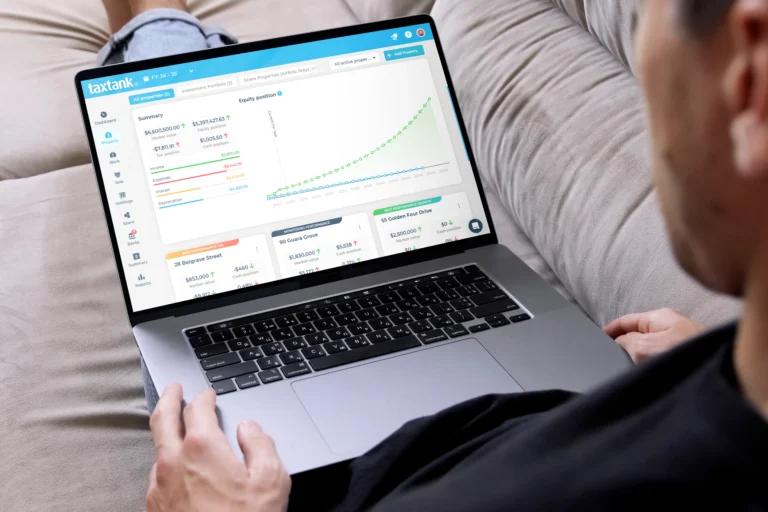
With the relevant Tanks, you can track employment income, sole trader activity, rental properties and investments, keep supporting documents organised, and see how recorded income and deductions affect your calculated personal tax position.
Live bank feeds through Open Banking help bring transactions into TaxTank. You can then allocate them to the relevant activity and retain the detail that a bank statement alone does not provide.
For property investors, that means bringing rental income, expenses, depreciation, ownership information and capital gains calculations into the same picture.
For employees and sole traders, it means seeing employment and business activity together, rather than treating each part of your financial life as a separate spreadsheet.
TaxTank helps you maintain your own financial and tax records. Its live tax summary reflects the information you have recorded, so keeping that information complete and accurate matters.
AI is more useful when it has something useful to work with
The growing role of AI in tax makes organised records more valuable.
An AI tool cannot reliably fill the gaps in information you never kept. A missing invoice is still missing. An unexplained transaction still needs context.
Before asking AI to help make sense of your finances, give it a financial picture worth making sense of.
That is the foundation behind TaxTank: connected transactions, supporting documents and Australian tax calculations, maintained throughout the year.
Because a clever answer is only helpful when the numbers underneath it hold up.
When tax “just happens”, know what is happening
A simpler digital tax experience sounds appealing. Less paperwork. Less repetition. Fewer hours trying to remember what happened last financial year.
But convenience should not mean handing over your understanding of your own finances.
You still want to know what you earned, what you spent, what you can support and how it affects your tax position.
The goal is not to outsmart the ATO’s algorithms. It is to arrive at tax time with records you understand and figures you can explain.
The ATO is keeping records. Make sure you are too.
Start your free 14-day TaxTank trial and bring your income, expenses, documents and live tax summary together.
Frequently asked questions
What is ATO data matching in Australia?
ATO data matching compares information received from third parties with information held by the ATO, including tax return records. It helps identify discrepancies and supports pre-filling.
Does the ATO use AI to check tax returns?
The ATO uses AI and machine learning to analyse information and identify risks. Predictive models can also generate prompts asking taxpayers to check unusual claims while preparing a return.
Does the ATO receive information about crypto?
Yes. The ATO has a dedicated crypto assets data-matching program covering information collected from designated service providers.
Should I check information that is already pre-filled?
Yes. Review pre-filled figures against your own records and add relevant information that is missing. The ATO’s myTax instructions explicitly require these checks for various income and deduction categories.
Can TaxTank show me ATO data matching results?
TaxTank helps you organise your own income, expenses, assets and supporting documents, and calculate your personal tax position using the information you record. It does not provide access to the ATO’s internal data-matching results.
How can I prepare for ATO data matching?
Keep your financial records current, retain supporting documents, check pre-filled information and review your figures before lodging. An organised record of what happened makes it easier to identify errors and explain differences.
Current ATO Data Matching Protocols
- AUSTRAC transaction report information 17 June 2021 to 30 June 2027 financial year
- Australian Financial Crimes Exchange (AFCX) data matching protocol
- Child support lodgment enforcement program data-matching protocol
- COVID-19 economic response support 2019–20 to 2021–22 financial years
- Commonwealth electoral roll
- Crypto assets data-matching program protocol to 2025–26
- Department of Home Affairs passenger movements
- Department of Home Affairs visa – data-matching program protocol
- Government payments program data-matching program protocol
- Higher Education Loan Program, Vocational Education and Training Student Loan and Trade Support Loans 2019–20, 2020–21 and 2021–22 financial years
- Income protection insurance 2021–22 to 2025–26 data-matching program protocol
- Landlord insurance 2021–22 to 2025–26 data-matching program protocol
- Lifestyle assets data-matching program protocol
- Medicare entitlement statement data-matching protocol
- Military super 2010–11 to 2021–22 financial years
- Motor vehicle registries data-matching program protocol
- Novated leases 2018-19 to 2025-26 data-matching program protocol
- Officeholder data-matching program protocol
- Offshore Merchant 2024–25 to 2026–27 financial years
- Online selling matching program protocol
- Paid parental leave superannuation contribution program
- Private health insurance statement – 2014-15 to 2027-28 financial years
- Property management data-matching program protocol
- Real property transactions data-matching program protocol
- Rental bond data-matching program
- Residential investment property loan 2021–22 to 2025–26 data-matching program protocol
- Ride sourcing 2015–16 to 2022–23 financial years data-matching program protocol
- Share transactions data-matching program protocol
- Sharing economy accommodation data-matching program protocol