
📚 Part 2 of the 2026 Tax Reform Series
Australia’s new Capital Gains Tax and Negative Gearing reforms work together, but each introduces different rules. This guide is part of a three-part series designed to explain the changes in plain English.
→ Part 1: Capital Gains Tax Changes: A Complete Guide
→ Part 2: CGT Changes: The Nitty Gritty (Where It Gets Controversial) (Current article)
→ Part 3: Part 3: Negative Gearing Rules: The Real Story Is Where Your Loss Goes to Live
Part 1 gave you the shape of it: indexation’s back, the 50% discount’s gone, and one gain can become two. Now let’s open the hood for these CGT changes, because this is where the reform stops being a tidy headline and starts being the kind of thing that starts arguments at accounting conferences.
The controversial one: pre-1985 assets are being pulled into the net
For forty years, assets acquired before 20 September 1985 sat outside CGT entirely. Bought a block of land in 1983? Gains were simply exempt. Full stop.
From 1 July 2027, that exemption ends for future growth. All pre-CGT assets are deemed to be sold and reacquired at market value on that date, and any gain accruing after it comes into the CGT net. The pre-2027 growth stays exempt, but the four-decade “get out of CGT free” card stops applying to anything that happens next. For long-held family assets, that’s a genuine shift, and it’s the change drawing the loudest objections.
The deemed-sale mechanic (nobody actually sells anything)
For assets held across the line, the law pretends you sold and instantly rebought them just before 1 July 2027. You didn’t. No money moves, no agent gets paid. But that notional event sets the boundary between the old-rules gain and the new-rules gain.
The notional gain or loss from that deemed sale is disregarded and deferred, it doesn’t get taxed then. It waits, quietly, until you actually sell. At that point two components surface:
- a deferred gain (the pre-2027 slice), taxed under the old rules, with the 50% discount if eligible; and
- a post-2027 gain, taxed under the new indexation regime.
The choice that quietly decides your tax bill
To set that boundary value, you’ll generally pick between two methods:
| Method | What it means | Status |
| Market value | Use the asset’s value at 1 July 2027 as the new cost base | The default |
| Apportionment | Use a Government formula that splits the gain by how long you held the asset before vs after the date | Formula set by the Minister via legislative instrument (still pending) |
These can produce meaningfully different outcomes. An asset that surged in value before 2027 might do better under market value (locking that growth into the discount era); one that’s expected to climb after might prefer apportionment. The apportionment formula isn’t fully published yet, so this is one to revisit once the legislative instrument lands.
Indexation: back, but with sharp edges
Everyone remembers indexation as “cost base goes up with inflation, so the gain goes down.” True as far as it goes, but the fine print bites, and it bites differently depending on the asset in front of you.
It’s applied asset by asset, cost by cost, not in one clean sweep.
Indexation isn’t a single percentage stamped across your whole gain. It’s worked out separately for each asset (each with its own purchase date and its own inflation run), and within each asset, separately for each element of the cost base. Your purchase price, your stamp duty, a 2029 renovation, each was spent at a different time, so each gets its own inflation adjustment. More precise, yes. Also a lot more moving parts.
Quarantined losses are counted, but never in your favour.
They’re applied against your gain at sale, but they take two hits on the way through, no inflation adjustment (the gain is lifted for inflation; the losses stay frozen), and where the 50% discount applies, they come off before it, so a dollar of loss ends up cancelling a gain that was only going to be half-taxed. Worth less than it looks.
It doesn’t help your prior year capital losses.
Here’s the asymmetry: there’s no indexation when you’re working out a capital loss. Your losses stay at face value, but the gains they offset have been lifted by inflation, so a nominal loss is chipping away at a CPI-adjusted gain. The inflation adjustment only ever runs in the direction that suits the tax office, not you.
The 12-month and residency gates still apply.
The asset has to be held at least 12 months, and residency conditions apply, which brings us to the nastiest trap of the lot.
The foreign-resident trap with the CGT changes
This one deserves a flashing light. If you’re a foreign resident for even a single day across the entire time you hold an asset, you lose indexation on it, not just for that day, for the whole hold. A stint working overseas years ago could quietly disqualify an asset you bought long before you ever left the country. It’s the kind of detail that stays invisible right up until the moment it’s expensive.
The 30% minimum tax, and why critics call it upside-down
A 30% minimum tax on gains sounds like a tax on the wealthy. But because it’s a floor, its real effect lands on people whose marginal rate would otherwise be below 30%.
The stated aim is to stop people timing a big sale for a low-income year, say, deferring a gain until after retirement to sneak into a lower bracket. Reasonable in intent. But the side effect is that a retiree or lower-income investor selling a long-held asset could end up paying more than they would have under the old discount, even after indexation. That’s the crux of the “this hurts the wrong people” critique, and it’s worth presenting honestly rather than glossing over.
A quirk for 1985–1999 assets
If you hold an asset acquired between 20 September 1985 and 21 September 1999, you currently get to choose between frozen indexation (locked at 30 September 1999 values) and the 50% discount. Once 1 July 2027 arrives, that choice disappears, only the 50% discount applies to the deferred pre-2027 component. A small group, but a real “use it or lose it” wrinkle.
Four buckets, not one
Before any of this can be taxed, gains get sorted into categories, because losses and adjustments don’t flow across them the same way:
| Category | Meaning |
| Deferred non-residential gain | Pre-2027 gain on a non-residential asset |
| Deferred residential gain | Pre-2027 gain on a residential asset |
| Non-residential gain | Post-2027 gain on a non-residential asset |
| Residential gain | Post-2027 gain on a residential asset |
The sorting is where the money hides, a residential loss pool may only reach residential gains, a deferred gain behaves differently from a fresh one, and the order losses apply in can change the final number.
Let’s run the numbers based on the CGT Changes
Say you bought a property for $500,000. On 1 July 2027 it’s worth $900,000 (your deemed cost base under the market-value method). Years later you sell for $1.2 million.
| Item | Amount |
| Original cost | $500,000 |
| Value at 1 July 2027 | $900,000 |
| Sale price | $1,200,000 |
| Total gain | $700,000 |
That splits into two worlds with the CGT changes:
| Component | Amount | Treatment |
| Deferred (pre-2027) gain | $400,000 | Old rules, 50% discount may apply |
| Post-2027 gain | $300,000 | Indexation applies; 30% minimum tax may bite |
The $400k half runs on the discount; the $300k half gets its cost base indexed and is then tested against the 30% floor. One sale, two calculations, and a gain that now needs a family tree. Noting some exceptions and exclusion may apply.
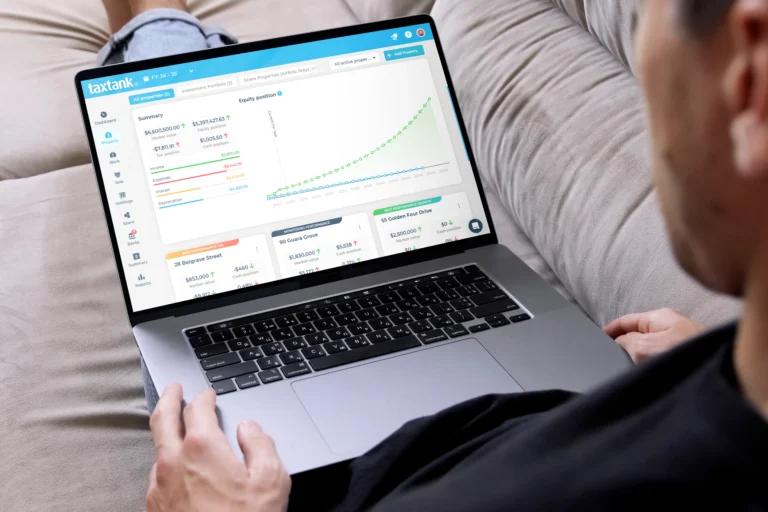
Where TaxTank fits in with the CGT Changes
None of this is impossible. It’s just un-rememberable, especially years down the track, across a handful of assets all bought under different rules.
And part that raises the stakes is that the ATO is a data powerhouse. Bank feeds, share registries, property transfers, crypto exchanges, rental bond boards, it flows in automatically, cross-matched and kept. The days of the tax office having a fuzzier picture than you did are long gone. When you sell, they’ll already have most of the pieces. The only question is whether you can assemble them as cleanly.
Because everything matters, and it matters year after year. The acquisition date. The original cost base. The value on 1 July 2027. Which transition method you picked. Which parts of the cost base are indexable. Whether the foreign-resident trap caught you. Which losses apply first, and whether the 30% floor kicks in. Miss one thread and the whole calculation unravels, usually not in your favour.
That’s a lot to reverse-engineer from a shoebox of statements a decade after the fact. And that the power of TaxTank.
TaxTank’s job is to keep each asset’s story intact as it happens, every date, every dollar, every improvement, every carried-forward loss, and to run every method and option in the background. So when you sell, you’re not scrambling to reconstruct a decade of history to match what the ATO already has. You know exactly where you stand.
The takeaway
The 2026 CGT changes aren’t just “goodbye 50% discount.” They pull pre-1985 assets into the net, add a floor that can penalise the wrong people, hide asymmetries in the indexation fine print, and turn every straddling asset into a two-part calculation. The most important question is no longer “how much did I sell it for?”, it’s “which slice of this gain are we actually taxing, and under which rules?”
And there’s one more thread to pull: these CGT rules don’t stay in their lane. They borrow losses from the negative gearing reforms, which is how two owners of the same property can end up with completely different tax bills.
Now, if you’re still with us, it might be time to pour yourself a glass of something stronger… because we’re about to dive into the negative gearing changes, and they may just blow your mind.
Continue reading the 2026 Tax Reform Series
Next: Part 3: Negative Gearing Rules: The Real Story Is Where Your Loss Goes to Live
Disclaimer: Based on the legislation and guidance available at the time of writing. The apportionment method and certain ATO guidance are still being finalised and may affect how some rules apply in practice.