


📚 Part 1 of the 2026 Tax Reform Series
Australia’s new Capital Gains Tax changes and Negative Gearing reforms work together, but each introduces different rules. This guide is part of a three-part series designed to explain the changes in plain English.
→ Part 1: Capital Gains Tax Changes: A Complete Guide (Current article)
→ Part 2: CGT Changes: The Nitty Gritty (Where It Gets Controversial)
→ Part 3: Negative Gearing Rules: The Real Story Is Where Your Loss Goes to Live
Australia just rewrote the rules on capital gains tax for the first time in over 25 years, and no, it’s not only a property thing. If you own shares, ETFs, managed funds or crypto, this one has your name on it too.
Announced in the 2026–27 Federal Budget and now passed into law, the Capital Gains Tax changes replace Australia’s long-standing 50% CGT discount with an inflation-based system, and add a 30% minimum tax on many capital gains. The new rules bite from 1 July 2027 which sounds comfortably far away, right up until you realise the records you’ll need then are the ones you’re creating right now.
First, a quick refresher: what is Capital Gains Tax?
CGT isn’t a separate tax with its own bill in the mail. It’s part of your income tax, triggered when you sell or dispose of certain assets at a profit. That profit generally gets added to your taxable income and taxed at your marginal rate.
Assets that can trigger CGT include investment property, Australian and international shares, ETFs, managed funds, cryptocurrency, and collectables. Your family home usually sits outside all of this, thanks to the main residence exemption, and reassuringly, that exemption isn’t changing.
A very short history of a very long argument
To understand why 2026 matters, it helps to know Australia has essentially had this debate before, and picked the other answer.
| Year | The rule of the day | What it meant for you |
|---|---|---|
| 1985 | CGT is born. Anything already owned is grandfathered as pre-CGT; new assets are indexed for inflation. | Buy from here on, and your cost base rises with inflation before tax applies. |
| 1985–1999 | The indexation era. | You’re taxed on the real gain, growth above inflation, not the full nominal figure. |
| 1999 | Following the Ralph Review, the Howard Government swaps indexation for a flat 50% discount on assets held 12+ months. | Simpler sums: halve the gain, tax the rest. |
| 2026 | The pendulum swings back with capital gains tax changes. Indexation returns (with a twist), the 50% discount goes (with exceptions), and a 30% minimum tax joins the party (also with exceptions). | One gain can now become two, split across the old and new rules. |
So indexation isn’t some radical new invention. It’s the system taxpayers navigated in the ’90s, except this time it arrives with a 30% floor, a stack of fine print, and far less simplicity than it left with.
What are the Capital Gains Tax changes?
Three headline shifts, at altitude:
1. Inflation indexation replaces the 50% discount, for most.
Instead of automatically halving your gain, the system lifts your cost base in line with inflation, so you’re taxed on the real gain, growth beyond inflation, rather than the full nominal figure. There are exceptions: new residential dwellings and affordable housing can still elect the discount, and companies and super funds keep their existing settings entirely (for now..).
2. A 30% minimum tax on many gains.
For gains accruing from 1 July 2027, a floor applies, though not to every gain or every taxpayer. We’ll unpack why this one’s controversial in Part 2 (spoiler: it can hit lower-income sellers harder, not just the wealthy).
3. Your one gain may become two.
For assets you already hold across 1 July 2027, the gain gets split, the part that built up before the date generally keeps the old 50% discount treatment, and the part after runs on the new indexation rules. Same asset, same sale, two different tax stories.
The part that trips everyone up with the Capital Gains Tax changes: this was never just a property story
Because the capital gains tax changes arrived holding hands with the negative gearing changes, the headlines fixated on rental properties. But CGT doesn’t care if your portfolio is made of bricks, shares, blockchain or a shoebox of rare coins, it casts the same wide net.
The new rules reach individuals, trusts and partnerships holding almost any CGT asset. A few investors who’ll be surprised to find themselves in scope:
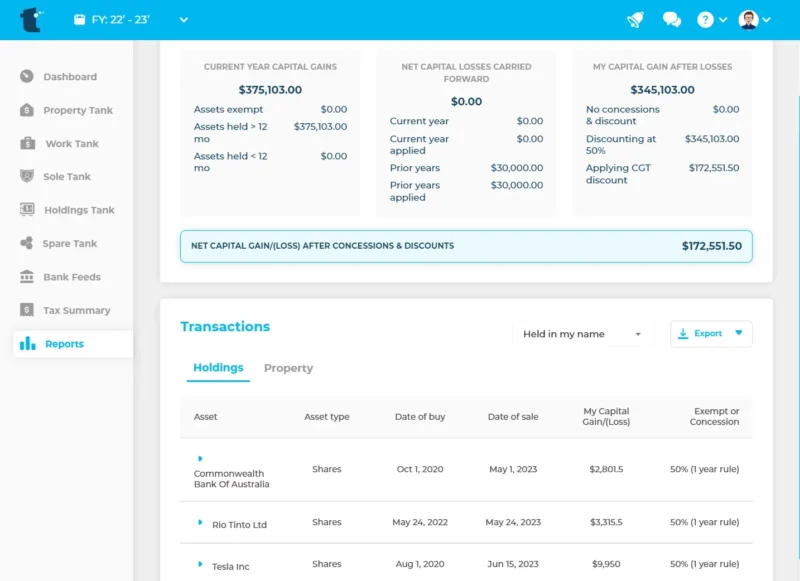
- The long-term share investor. That parcel of ASX shares you’ve held since 2020? Sell in 2028 and the growth after 1 July 2027 runs on indexation plus the possible 30% floor, not the tidy 50% discount you’d mentally banked.
- The ETF or managed fund holder. Here’s the one that catches people out: funds get you two ways in. First, when you sell your units, same split treatment as shares across the transition date. Second, and less obvious, when the fund sells assets inside the wrapper and distributes the capital gains out to you. Most ETFs and managed funds are structured as trusts, so those gains can land in your tax return in a year you didn’t sell a single unit. Worth knowing: exactly how the new rules mesh with the trust rules these funds run on is one of the pieces still being finalised so this is a space to watch, and a reason to keep clean records now rather than untangle them later.
- The crypto holder. Selling, swapping, even trading one coin for another is a CGT event. The same split-gain logic applies across the transition date, your wallet history is now tax history and the ATO already collects the data.
- The collector. Art, classic cars, fine wine, rare coins, jewellery, collectables are CGT assets too, and they don’t escape the new regime. Gains across the transition date split like everything else. Point to note, collectables come with their own quirks, like losses that can only offset other collectable gains, but that’s a rabbit hole for another day.
A few players do get waved through untouched: companies, super funds and life insurance companies keep their existing CGT settings.
Why this matters even if you’re not selling anytime soon
CGT feels like a sale-day event, so it’s tempting to file this under a “future me problem.” But the outcome is stitched together from the entire life of the asset when you bought it, what you spent and when, what it was worth on 1 July 2027, and which rules apply to which slice and in what order.
Miss those breadcrumbs now, and you’re reconstructing them years later from bank statements and vibes.
The key takeaway
The 2026 Capital Gains Tax changes are the biggest shake-up since 1999, they reach well beyond property, and they turn a single gain into a two-part story for anything you hold across 1 July 2027. For a simple asset, the sums stay manageable. For a real portfolio, less so.
So are you comfortable with the big picture and ready for the parts that are genuinely contentious? Want to understand just how complex these changes are to calculate?
Continue reading the 2026 Tax Reform Series
Next: Capital Gains Tax Changes: The Nitty Gritty →
Disclaimer: Based on the legislation and guidance available at the time of writing. The CGT changes apply to gains accruing from 1 July 2027, but some implementation details — including the apportionment method and ATO indexation guidance — are still being finalised and may affect how some rules apply in practice.