


As artificial intelligence (AI) becomes more mainstream, Australians are increasingly searching for terms like “AI tax agent”, “AI tax return” and “AI tax software”.
The promise sounds appealing. Upload a few documents, ask a chatbot some questions, and let AI handle your tax return.
But before you hand over your financial information to a generic AI tool, it’s worth understanding the risks, limitations and what AI can realistically do when it comes to Australian tax.
The reality is that not all AI is created equal. While AI can play a valuable role in tax management, relying on a general-purpose AI chatbot to prepare your tax return could lead to mistakes, missed deductions, privacy concerns and incorrect tax outcomes.
Why are people searching for AI Tax Agents?
Most Australians don’t want to become tax experts.
They want a simple way to:
- Track deductible expenses
- Understand their tax position
- Calculate capital gains tax
- Manage investment properties
- Manage logbooks and work from home
- Record sole trader income and expenses
- Prepare for tax time
AI appears to offer an easy solution. Instead of learning tax rules, people can simply ask questions and receive answers instantly.
The challenge is that tax isn’t just about answering questions.
Tax requires accurate calculations, complete records, supporting evidence, legislative interpretation and access to transaction-level data.
That’s where generic AI tools can fall short.
The problem with using generic AI for tax returns
AI only knows what you tell it
Most AI chatbots can only work with the information you manually provide.
If you forget to mention:
- An investment property
- Capital improvements
- Borrowing costs
- Depreciation claims
- Prior year losses
- Capital gains events
- Work-related expenses
The AI has no way of knowing.
Unlike dedicated tax software, generic AI cannot automatically monitor your financial transactions throughout the year.
The result is often incomplete information leading to incomplete tax outcomes.
AI can make confident mistakes
One of the biggest concerns with AI is that it can sound very convincing even when it’s wrong.
Australian tax law is complex and constantly changing.
An AI tool may:
- Apply outdated tax rules
- Misinterpret your situation
- Confuse overseas tax rules with Australian tax law
- Overlook important exceptions
- Recommend deductions you’re not entitled to claim
The ATO has repeatedly warned taxpayers that they remain responsible for the accuracy of their tax returns, regardless of where the information came from.
If an AI provides incorrect guidance, the liability still sits with the taxpayer.
AI doesn’t automatically verify your records
Tax returns rely on evidence.
You need records for:
- Income
- Expenses
- Investments
- Property transactions
- Vehicle use
- Home office claims
- Capital works and depreciation
An AI conversation cannot verify whether your records are complete or accurate.
Without proper data collection and record keeping, even the smartest AI cannot produce reliable tax outcomes.
Privacy concerns when sharing financial information with AI
Many Australians are now entering highly sensitive information into AI chatbots without fully understanding how that information is handled.
This may include:
- Tax file numbers
- Bank account information
- Income details
- Investment portfolios
- Property ownership information
- Business financial records
Before sharing financial data with any AI platform, it’s important to understand:
- Where the data is stored
- Whether it may be used for model training
- Who has access to the information
- How long the data is retained
- Whether the platform complies with Australian privacy requirements
For most taxpayers, providing detailed financial information to a public AI chatbot introduces risks that should be carefully considered.
The future of AI in tax
AI will absolutely play a larger role in tax management.
The question isn’t whether AI will be used.
The question is how it will be used.
The most effective tax solutions will combine:
- Automated calculations
- Structured financial data
- Australian tax rules
- Secure record keeping
- Real-time transaction monitoring
- Intelligent assistance
Rather than asking users to manually explain their finances, future tax tools will work from the underlying data itself.
This allows calculations to happen automatically and consistently throughout the year.

Why automated tax software is different
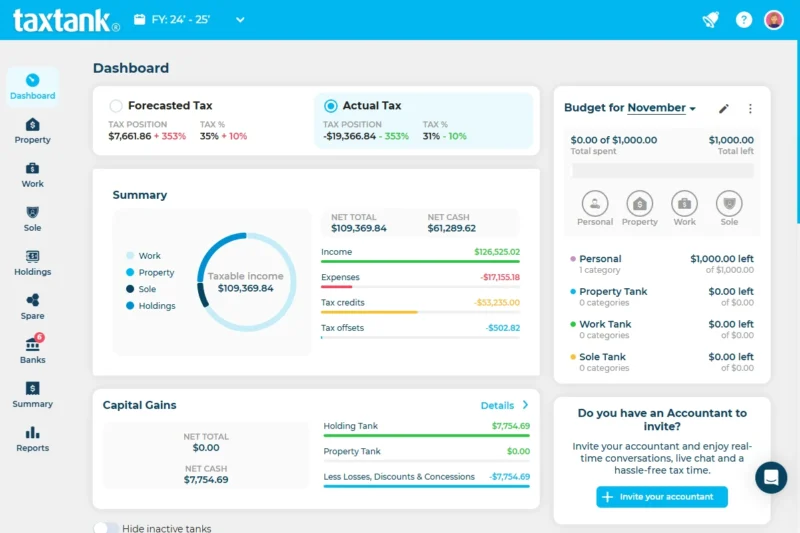
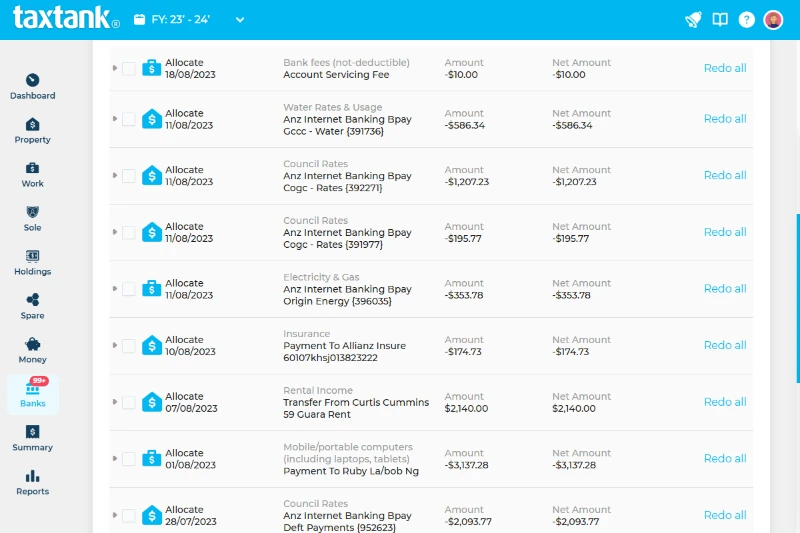
The biggest limitation of generic AI is that it relies on conversations.
Dedicated tax software relies on data.
Instead of asking:
“Can I claim this expense?”
The software already knows:
- What the expense was
- When it occurred
- Which account it came from
- Which asset or property it relates to
- Whether depreciation rules apply
- How it affects your estimated tax position
This creates a far more reliable foundation for tax calculations.
Why TaxTank is a better alternative to an AI tax agent
TaxTank was built specifically for Australian tax management.
Rather than relying on prompts and conversations, TaxTank calculates tax outcomes automatically in the background as your financial information is recorded.
TaxTank helps Australians:
Track tax year-round
Tax isn’t just a June problem.
TaxTank provides visibility into your estimated tax position throughout the year so there are fewer surprises at tax time.
Connect your financial data
With live bank feeds and transaction tracking, TaxTank works from real financial data rather than relying on information manually typed into a chatbot.

Automatically apply Australian tax rules
TaxTank is built around Australian tax legislation and reporting requirements.
This helps ensure deductions, depreciation, capital gains and borrowing costs are treated correctly as transactions occur.
Manage more than just tax returns
TaxTank helps you manage:
- Work-related expenses
- Investment properties
- Sole trader income and expenses
- Shares and ETFs
- Cryptocurrency investments
- Budgets and financial goals
All within a single platform.
Maintain better records
Accurate tax outcomes depend on accurate records.
TaxTank helps you organise supporting documentation and maintain records throughout the year rather than scrambling at tax time.
Should you use AI for your tax return?
AI can be useful for learning about tax concepts and understanding general information.
However, when it comes to calculating tax outcomes, tracking deductions and preparing for tax time, relying solely on a generic AI chatbot carries significant risks.
The better approach is to use software designed specifically for Australian tax management that can apply tax rules automatically using your actual financial data.
That gives you the benefits of automation without relying on incomplete conversations or guesswork.
Final thoughts
AI is changing the way Australians manage their finances.
But tax is still a data problem before it becomes an AI problem.
The most accurate tax outcomes come from structured financial records, automated calculations and software built specifically for Australian tax law.
Instead of asking an AI chatbot to estimate your tax position from a conversation, consider using a platform that calculates it automatically throughout the year based on your real financial information.
That’s the difference between asking questions about your tax and actually managing it.
FAQs
Can AI do my tax return in Australia?
AI can assist with tax-related questions and provide general guidance, but taxpayers remain responsible for the accuracy of their tax returns. Generic AI tools may not have access to all the information needed to calculate your tax correctly.
Is it safe to enter financial information into AI?
Before entering financial information into any AI platform, you should understand how your data is stored, used and protected. Sensitive financial information should only be shared with platforms that meet your privacy and security requirements.
Can AI calculate Australian tax accurately?
AI can perform calculations when provided with the correct information, but the accuracy depends entirely on the quality and completeness of the data supplied. Missing information can lead to incorrect outcomes.
What is the best alternative to an AI tax agent?
Purpose-built Australian tax software like TaxTank that automatically applies tax rules using your financial data generally provides more reliable results than relying on a generic AI chatbot conversation.
Does TaxTank use AI?
Yes. TaxTank uses AI-powered chat functionality to help users find information, navigate the platform and get answers to questions based on our help articles and product guidance.
However, TaxTank’s tax calculations don’t rely on AI conversations or prompts. Instead, TaxTank automatically applies Australian tax rules to your financial data in the background, helping you track your tax position throughout the year using structured financial information and purpose-built tax calculations.
This means you get the convenience of AI-assisted support, while your tax calculations are driven by dedicated tax software rather than chatbot-generated estimates.
Is AI replacing tax accountants?
AI is unlikely to replace tax accountants entirely. Instead, it is helping automate repetitive tasks such as data entry, document processing, research and calculations, allowing accountants to spend more time providing professional judgement, strategic advice and support for complex tax situations.
In fact, many accounting firms are already using AI in various forms to improve efficiency and streamline parts of their workflow. As AI technology continues to evolve, it’s more likely that accountants will work alongside AI-powered tools rather than be replaced by them.
The ATO is also investing heavily in automation, artificial intelligence and data matching technologies to monitor compliance, identify discrepancies and analyse taxpayer data at scale. While the tax system is becoming increasingly automated behind the scenes, many individuals are still relying on spreadsheets, paper records and manual calculations to manage their own tax affairs.
For most taxpayers, the future is likely to be a combination of automation, AI assistance and professional expertise where needed. As the ATO, software providers and accounting firms continue adopting these technologies, it’s becoming increasingly important for individuals to take advantage of tools that help them manage their tax more accurately and efficiently throughout the year.
Can AI help property investors with tax?
AI may provide general information about property tax rules, but property investors often have complex considerations such as depreciation, borrowing expenses, capital works, capital gains tax and ownership structures that require accurate data and specialised calculations.
Can AI calculate capital gains tax?
AI can explain how capital gains tax works, but calculating CGT accurately often requires detailed transaction histories, acquisition costs, brokerage records, corporate actions, improvements and ownership information. Dedicated software is generally better suited to these calculations.
Ready to move beyond AI tax estimates?
While AI can help answer tax questions, accurate tax outcomes depend on something more important: your financial data.
TaxTank automatically tracks your income, expenses, investments and tax position throughout the year, applying Australian tax rules in the background so you can stay on top of your tax without relying on spreadsheets, manual calculations or chatbot-generated estimates.
Join thousands of Australians using TaxTank to manage their tax year-round and see your estimated tax position in real time.
Start your 14-day free trial today and discover a smarter way to manage your tax.