


Editor’s Note (July 2026): This article has been updated following the passage of the Federal Government’s negative gearing and capital gains tax legislation through Parliament. The reforms will apply from 1 July 2027, with existing investment properties and other grandfathering provisions protected. We will continue updating this article as further guidance and explanatory materials are released.
Latest Update: Negative Gearing Changes Have Now Passed Parliament
The Federal Government’s changes to negative gearing and capital gains tax have now passed Parliament following support from the Greens.
The legislation confirms that negative gearing will generally be restricted to newly built residential properties purchased from 1 July 2027, while existing investment properties purchased before Budget Night (12 May 2026) will remain under the current rules.
The legislation also confirms new restrictions on SMSF borrowing for residential property, while preserving existing borrowing arrangements through grandfathering provisions.
For property investors, the focus now shifts from understanding what was proposed to understanding how the new rules will affect future investment decisions.
Quick Snapshot Of The New Negative Gearing Rules
| Change | Current Proposal |
|---|---|
| Established Residential Properties | Rental losses from established residential properties purchased after Budget Night (7:30 PM AEST on 12 May 2026), can no longer offset salary, wages or other non-property income. |
| Grandfathering | Existing investment properties held before Budget Night (7:30 PM AEST on 12 May 2026) remain under the current rules. |
| New Residential Builds | Newly built residential properties would continue to qualify for full negative gearing benefits. |
| Property Portfolio Offsets | Losses appear likely to remain available to offset profits from other residential investment properties within a portfolio. |
| Capital Gains Tax | The current 50% CGT discount would be replaced with an inflation-adjusted discount model and a minimum 30% CGT rate. |
| SMSF Borrowing | New borrowing arrangements through SMSFs for residential property would no longer be permitted. Existing arrangements are expected to be grandfathered. |
| Parliamentary Status | Passed. Commences 1 July 2027. |
What Changed Following The Labor-Greens Agreement?
One of the most significant changes included in the final legislation is the restriction on new SMSF borrowing arrangements for residential property.
Currently, SMSFs can use limited recourse borrowing arrangements (LRBAs) to acquire residential investment properties. Under the agreement reached between Labor and the Greens, new borrowing arrangements for residential property will no longer be permitted from the commencement date.
Importantly, existing SMSF borrowing arrangements and residential properties already held through those arrangements are protected under the legislation’s grandfathering provisions..
While the broad direction of the reforms is now clearer, investors are still waiting for the final legislation and explanatory materials to understand exactly how the rules will operate in practice.
What Has Changed Under The New Negative Gearing Rules?
Under the new legislation, negative gearing will generally be limited to newly built residential properties purchased from 1 July 2027. Existing investment properties held before Budget Night (12 May 2026) remain grandfathered under the current rules.
Can You Still Offset Property Losses Across Your Portfolio?
The Good News (Sort Of)
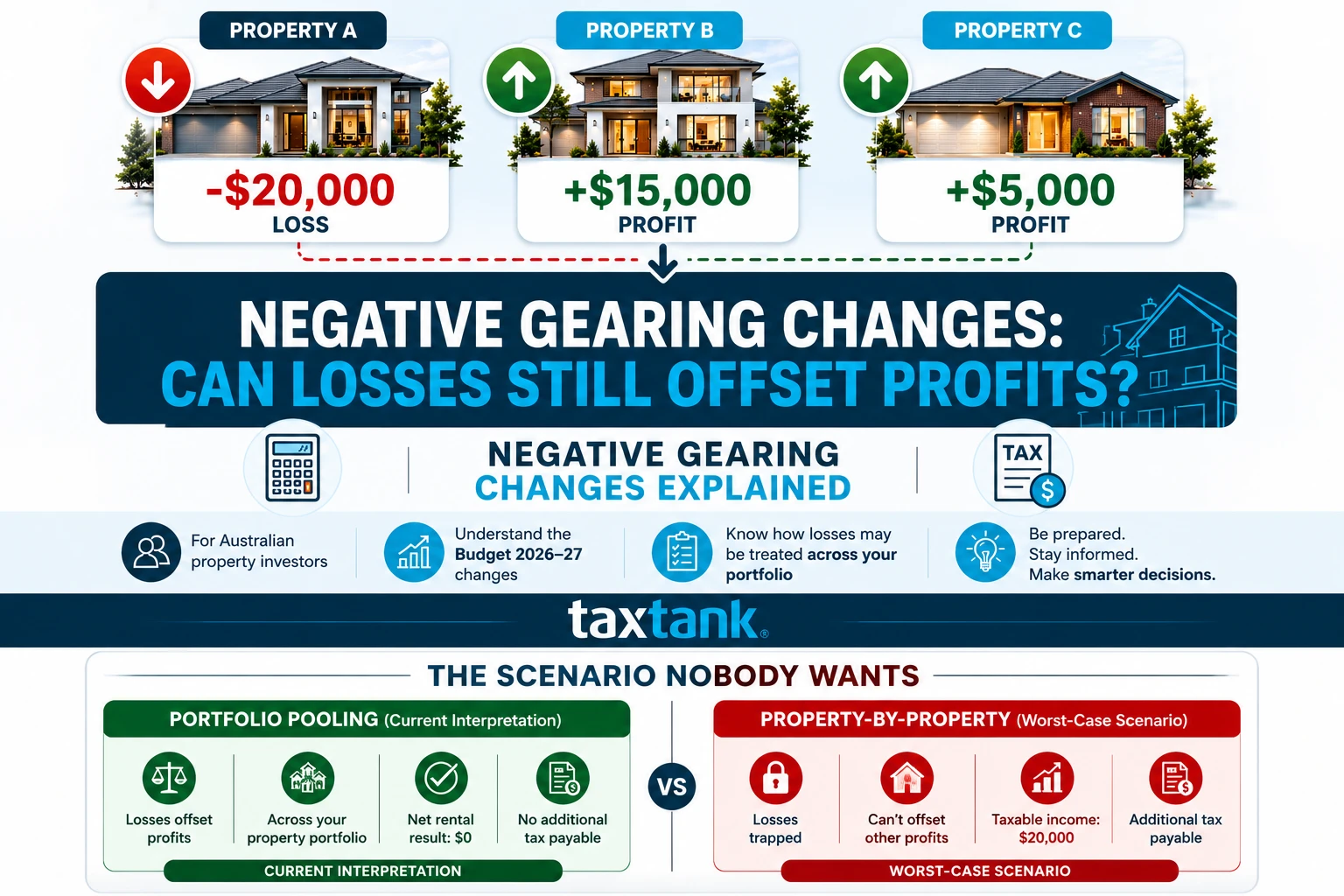
Based on the legislation that has now passed Parliament, the negative gearing changes do not appear to quarantine losses on a property-by-property basis.
Instead, the current understanding is that losses from affected residential properties would be quarantined within a residential property pool.
In plain English:
If one property loses money and another property makes money, the loss can still offset the profit.
| Property | Annual Result |
| Property A | ($20,000) Loss |
| Property B | $15,000 Profit |
| Property C | $5,000 Profit |
Under the new rules, the $20,000 loss would likely offset the $20,000 profit from the other properties.
Net result?
Zero taxable rental income.
So far, so good.
What Changes?
The major change is that losses from affected established residential properties would no longer be used to reduce:
- Salary and wages
- Business income
- Interest income
- Other non-property income
Instead, those losses would generally be restricted to:
- Residential rental income
- Future residential property capital gains
In other words, the Government appears to be saying:
“We’re still happy for property losses to offset property profits… we just don’t want them offsetting everything else.”
The Scenario Nobody Wants
Now imagine a different version.
Let’s say losses were quarantined per property.
Using the same example:
| Property | Annual Result |
| Property A | ($20,000) Loss |
| Property B | $15,000 Profit |
| Property C | $5,000 Profit |
Under a strict property-by-property system:
- You would pay tax on the $20,000 profit from Properties B and C.
- The $20,000 loss from Property A would be trapped.
- You couldn’t use it until that specific property became profitable or was sold.
That would be a dramatically harsher outcome.
Fortunately, that’s not what the Government appears to be proposing.
At least not yet.
The Remaining Questions
And this is where things get interesting.
While the legislation has now passed, investors are still waiting for additional ATO guidance and explanatory material on several practical issues.
Questions still remain around:
- Trust ownership structures
- Mixed-use properties
- Former principal residences
- Carried forward losses
- How future capital gains will interact with quarantined losses
- Ownership percentages and joint ownership arrangements
As always, the devil isn’t in the headline.
It’s buried somewhere around page 437 of the explanatory memorandum.
What Do These Negative Gearing Changes Mean For Investors?
For investors with multiple properties, the impact may be significantly less severe than many headlines suggest.
Under the new legislation, portfolios with a mix of positively and negatively geared properties may still be able to offset losses against profits within the portfolio.
The biggest impact falls on investors who currently rely on rental losses to reduce PAYG income each year.
Those annual tax refunds could look very different in the future.
As more detail emerges around the new negative gearing reforms, investors will need to closely monitor how the legislation is drafted and ultimately implemented.
The TaxTank Take
One of the biggest consequences of these reforms is that many investors will now have portfolios operating under multiple tax rules at the same time.
Some properties may remain under the previous negative gearing rules through grandfathering, while future purchases may fall under the new regime.
Add capital gains tax changes, SMSF reforms and future legislative updates, and tracking everything manually becomes increasingly difficult.
That’s exactly why TaxTank was built.
Rather than replacing old tax rules each time legislation changes, TaxTank automatically applies the correct rules based on when each property was acquired. That means grandfathered properties continue under their existing treatment, while newer properties follow the latest legislation, all within the same portfolio.
As Australia’s property tax system becomes more layered, software that understands those layers becomes increasingly valuable.
Key Takeaways
- Existing investment properties purchased before Budget Night (12 May 2026) remain grandfathered.
- Negative gearing will generally be limited to newly built residential properties purchased from 1 July 2027.
- Property losses can continue to offset other residential property income within a portfolio.
- Losses from affected properties can no longer reduce salary and other non-property income.
- New SMSF borrowing arrangements for residential property will no longer be permitted.
- Investors may now need to manage multiple tax treatments across a single property portfolio.
Frequently Asked Questions About The Negative Gearing Changes
Will negative gearing be abolished?
No. The current proposal limits negative gearing on certain residential properties purchased after 1 July 2027, while existing properties are expected to be grandfathered.
Can property losses still offset other properties?
Based on current information, losses appear likely to be pooled across residential properties rather than quarantined to individual properties.
When do the negative gearing changes start?
The commencement date is 1 July 2027, subject to legislation being passed.
Will existing investment properties be affected?
Properties held before Budget night are expected to remain under the current rules.
Why is the Government making the negative gearing changes?
According to the Federal Budget announcement, the negative gearing reforms are intended to encourage investment in new residential housing and increase housing supply.
Have the negative gearing changes passed Parliament?
Yes. The legislation has now passed Parliament following support from the Greens. The new rules commence on 1 July 2027, with grandfathering protections applying to eligible existing investments.
What are the latest negative gearing changes?
The latest developments include an agreement between Labor and the Greens supporting the new negative gearing reforms, capital gains tax changes and restrictions on new SMSF borrowing arrangements for residential property. Existing investment properties and existing SMSF borrowing arrangements are expected to be grandfathered.
How can property investors keep track of the negative gearing changes?
As property tax rules become more complex, many investors are moving away from spreadsheets and annual tax estimates towards software that tracks rental income, expenses, depreciation and tax outcomes throughout the year.
Understanding your real-time property position can make it easier to assess the impact of future negative gearing, capital gains tax and property deductions before tax time arrives.
What happens if negative gearing rules change again?
Property tax legislation changes regularly and future governments may introduce additional reforms.
For property investors, this makes it increasingly important to understand not only current rental performance but also the long-term tax implications of their investment strategy, including capital gains tax, carried forward losses and cash flow impacts.
How can I calculate the impact of the negative gearing changes on my portfolio?
The impact will depend on factors such as:
• The number of properties you own
• Whether properties are positively or negatively geared
• Your taxable income
• Available depreciation deductions
• Future capital gains
Because every portfolio is different, investors often benefit from modelling multiple scenarios to understand how the new changes could affect both annual tax outcomes and long-term wealth creation.
Is a spreadsheet enough to manage investment property tax?
For investors with a single property, a spreadsheet may be sufficient.
However, as portfolios grow and tax rules become more complex, many investors find it difficult to accurately track rental income, expenses, depreciation, capital gains tax, carried forward losses and changing tax legislation across multiple properties.
Having visibility over your property portfolio throughout the year can make it easier to understand the impact of tax changes before lodging your tax return.
How can TaxTank help property investors manage tax rule changes?
TaxTank helps Australian property investors track rental income, expenses, depreciation, capital gains tax and tax outcomes in real time.
Instead of waiting until tax time to understand the impact of changing legislation, investors can see how their property portfolio is performing throughout the year and make more informed decisions as tax rules evolve.
How can investors manage grandfathered tax rules across multiple properties?
One of the challenges created by the new negative gearing changes is that investors may end up managing multiple tax treatments across a single portfolio.
For example, an investor may own:
• Existing properties that remain under current negative gearing rules
• New properties purchased after the commencement date that fall under the new rules
• Properties with different capital gains tax treatments depending on when they were acquired
• Grandfathered SMSF investments alongside new investment structures
As tax legislation becomes more layered, accurately tracking which rules apply to which property can become increasingly difficult using spreadsheets alone.
This is where software like TaxTank can play an important role by automatically applying the correct tax treatment based on acquisition dates, ownership structures and legislative changes, helping investors maintain accurate records as rules evolve over time.
Why does TaxTank grandfather tax rule changes?
TaxTank is designed to reflect the tax rules that apply to each asset or property based on when it was acquired.
When legislation changes, we don’t simply overwrite historical rules. Instead, TaxTank maintains the correct treatment for grandfathered assets while applying new rules where required.
This means investors can continue managing their portfolio in one place without needing separate spreadsheets or manual calculations to track different tax treatments across different properties.
As governments introduce new property tax measures, capital gains tax reforms or the negative gearing changes, TaxTank updates the underlying rules so investors can focus on understanding the impact rather than calculating it themselves.