
As artificial intelligence becomes more popular, many Australians are asking the same question:
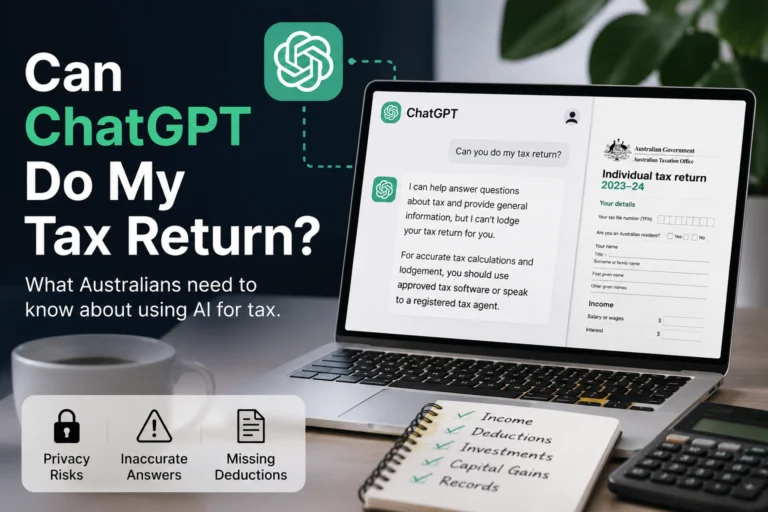
Can ChatGPT do my tax return?
It’s easy to see why.
ChatGPT can answer questions, write emails, explain tax concepts and even help with calculations. So surely it can prepare a tax return too?
The short answer is: not safely, not completely, and not without significant risks.
While ChatGPT can be useful for understanding tax concepts and learning about deductions, it’s important to understand what it can and can’t do before relying on it for your tax return.
Can ChatGPT prepare an Australian tax return?
ChatGPT can generally help explain:
- How Australian tax works
- Common tax deductions
- Capital gains tax concepts
- Investment property tax rules
- Sole trader tax obligations
- Record-keeping requirements
However, ChatGPT cannot independently prepare an accurate Australian tax return because it does not have direct access to your complete financial information.
Unlike dedicated tax software, ChatGPT doesn’t automatically know:
- Your income
- Your bank transactions
- Your investment history
- Your property ownership details
- Your depreciation schedules
- Your borrowing expenses
- Your prior year tax information
It only knows what you tell it.
If important information is missing, the advice or calculations may be incomplete or incorrect.
Why ChatGPT can get tax answers wrong
One of the biggest misconceptions about AI is that it always knows the correct answer.
In reality, ChatGPT predicts responses based on patterns in information it has learned. It does not independently verify your personal circumstances.
This can lead to situations where ChatGPT:
Applies the wrong tax rules
Australian tax law is complex and changes regularly.
An AI tool may:
- Reference outdated legislation
- Apply overseas tax rules
- Miss recent ATO guidance
- Overlook important exceptions
Even small mistakes can affect your tax outcome.
Doesn’t know what it’s missing
Many taxpayers don’t realise how much information affects their tax position.
For example, a property investor may forget to mention:
- Capital improvements
- Loan establishment fees
- Depreciation schedules
- Ownership percentages
- Capital works deductions
If ChatGPT doesn’t know about them, it can’t include them.
Sounds confident even when incorrect
One of the biggest challenges with AI is that incorrect answers can sound extremely convincing.
A response may appear detailed and professional while still containing factual errors.
That’s why information provided by AI should always be verified before being relied upon for tax purposes.
What does the ATO say about AI?
The ATO has acknowledged that taxpayers are increasingly using AI tools to assist with tax-related activities.
However, the responsibility for the accuracy of a tax return remains with the taxpayer.
Using AI is not a defence if:
- Deductions are overstated
- Income is omitted
- Tax calculations are incorrect
- Records cannot support claims
Whether information comes from a website, a friend, social media or an AI chatbot, taxpayers remain responsible for ensuring their return is correct.
Is it safe to upload tax documents to ChatGPT?
Before uploading tax records, bank statements or financial documents into any AI platform, it’s important to understand how that information is handled.
Potential concerns include:
- Data storage practices
- Retention periods
- Third-party access
- Privacy policies
- Future use of submitted information
Many people would never email their entire financial history to a stranger, yet some are uploading the same information into AI tools without fully understanding how that data is managed.
When dealing with sensitive financial information, privacy and security should always be considered.
The hidden problem: Tax is a data problem
The biggest limitation of using ChatGPT for tax isn’t intelligence.
It’s data.
A tax return isn’t simply a collection of questions and answers.
It requires:
- Complete financial records
- Accurate transaction history
- Supporting documentation
- Ongoing record keeping
- Consistent application of tax rules
Without reliable data, even the most advanced AI can only make assumptions.
That’s why successful tax management starts with capturing and organising information correctly throughout the year.
Why tax software works better than ChatGPT
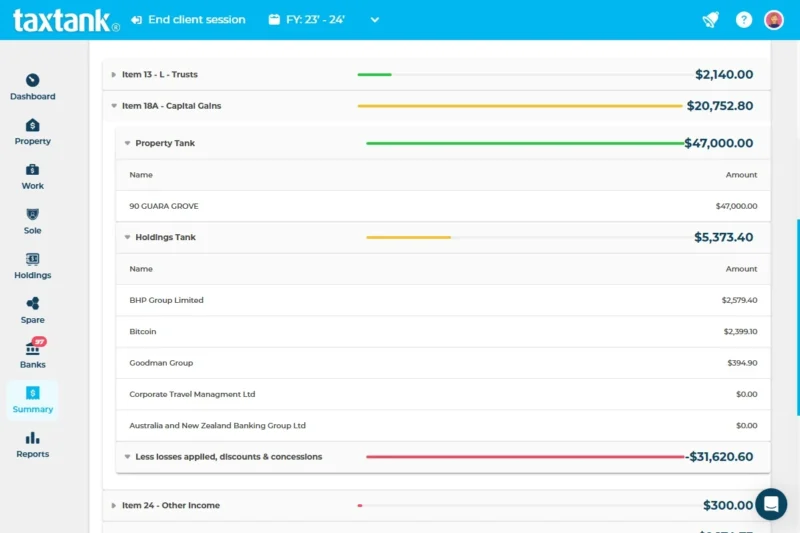
Rather than relying on a conversation, it works from actual financial data.
For example, software can:
- Import transactions automatically
- Track expenses throughout the year
- Monitor investment activity
- Calculate depreciation
- Apply Australian tax treatments
- Generate tax reports
This creates a more accurate foundation for tax calculations.
The software isn’t guessing based on a prompt.
It’s calculating based on real information.Dedicated tax software approaches the problem differently.
Why TaxTank is a better alternative than ChatGPT for doing your tax
If you’re considering using ChatGPT to manage your tax, it’s worth asking a different question:
Why not use software that’s already designed to calculate tax automatically?
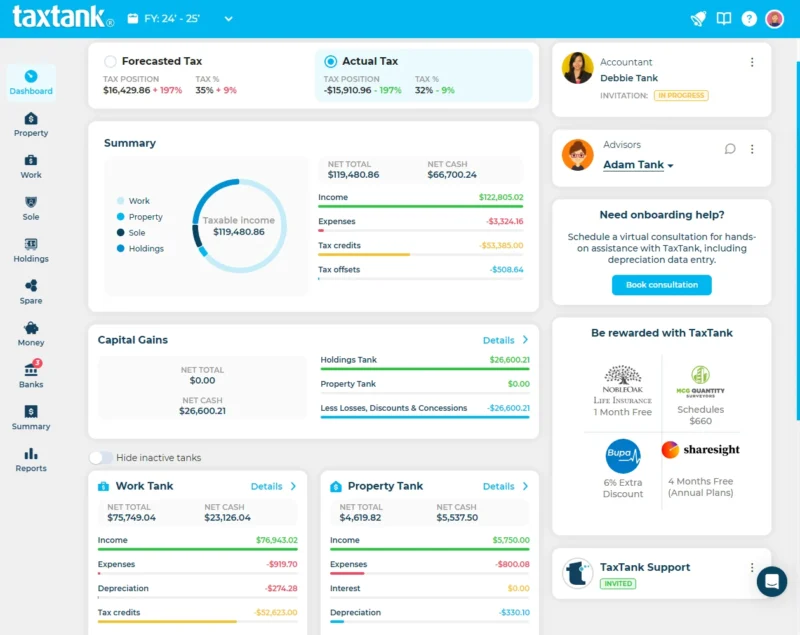
TaxTank helps Australians manage their tax year-round using actual financial data rather than relying on chatbot conversations.
Live Financial Data
TaxTank uses live bank feeds and transaction tracking to help ensure calculations are based on real financial information.
Real-Time Tax Visibility
Instead of waiting until tax time, TaxTank helps users understand their estimated tax position throughout the year.
Built For Australian Tax
TaxTank is designed specifically for Australian taxpayers and supports:
- Employees
- Property investors
- Sole traders
- Share investors
- Cryptocurrency investors
Automatic Tax Calculations
As transactions are allocated, TaxTank applies the appropriate tax treatment in the background.
This reduces the need to manually calculate deductions, depreciation, capital gains and other tax adjustments.
Better Record Keeping
TaxTank helps users maintain records throughout the year, making tax time easier and reducing the risk of missing deductions.
So, the answer to “Can Chatgpt do my tax return” is…
That technically, ChatGPT can help explain tax concepts and answer questions.
But preparing an accurate tax return requires much more than answering questions.
It requires:
- Complete financial data
- Accurate records
- Current tax rules
- Consistent calculations
- Ongoing management
For that reason, ChatGPT should be viewed as a learning tool rather than a replacement for dedicated tax software.
Final thoughts
Artificial intelligence is changing how people access information.
But when it comes to tax, information alone isn’t enough.
Accurate tax outcomes depend on complete records, correct calculations and software built specifically for the task.
ChatGPT can help you understand tax.
Purpose-built tax software helps you manage it.
Frequently asked questions
Can ChatGPT calculate my tax refund?
ChatGPT can estimate a tax refund if you provide accurate information, but the result may not reflect your complete tax situation. Missing deductions, income sources or tax adjustments can affect the calculation.
Can ChatGPT lodge a tax return?
No. ChatGPT cannot lodge a tax return with the ATO.
Is ChatGPT accurate for Australian tax advice?
ChatGPT can provide useful information, but it may occasionally provide incorrect, outdated or incomplete answers. Tax information should always be verified before being relied upon.
Can ChatGPT calculate capital gains tax?
ChatGPT can explain how CGT works, but accurate calculations often require detailed transaction records, acquisition costs, brokerage fees, ownership information and historical data.
Is it safe to upload tax documents to ChatGPT?
Before uploading financial documents to any AI platform, you should review the platform’s privacy and data handling policies and consider whether you’re comfortable sharing sensitive information.
What is the best alternative to ChatGPT for tax?
Dedicated Australian tax software like TaxTank that automatically applies tax rules using your financial data is generally a more reliable option for managing tax obligations.
Can ChatGPT help property investors with tax?
ChatGPT can explain general property tax concepts, but property investors often have complex deductions and calculations that require specialised software and accurate financial records.
Does TaxTank calculate tax automatically?
TaxTank applies tax treatments as transactions are recorded, helping users understand their tax position throughout the year rather than relying on manual calculations at tax time.
Don’t ask AI to guess your tax position
The quality of any AI answer depends on the information you provide.
TaxTank takes a different approach.
By connecting your financial data and applying Australian tax rules automatically, TaxTank helps you understand your tax position based on actual transactions, not assumptions.
Join thousands of Australians using TaxTank to track their tax year-round and discover a smarter alternative to spreadsheets, last-minute calculations and chatbot-generated estimates.
Start your free 14-day trial today.