

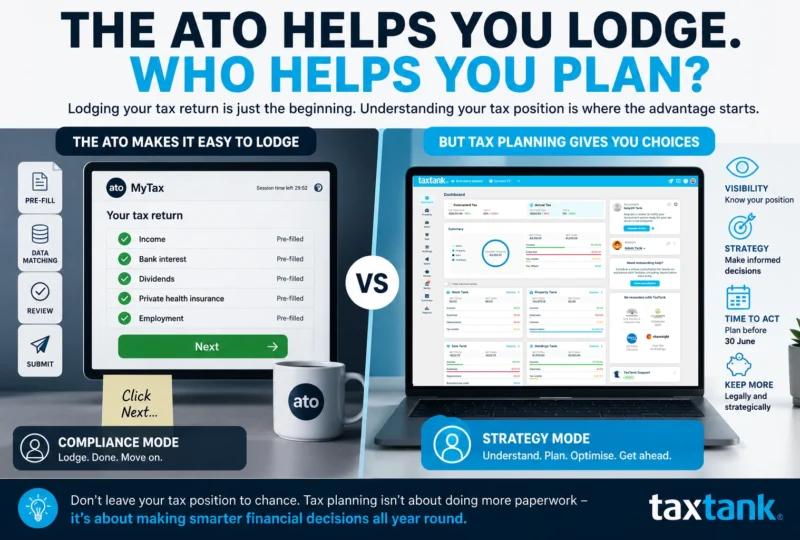
And why the ATO doesn’t really want you thinking about tax and just clicking next instead.
Tax planning isn’t about knowing every section of the Income Tax Assessment Act.
It’s about understanding your tax position before the financial year ends, not after.
Yet as the ATO continues to automate more of the tax return process through MyTax, pre-fill data and data matching, many Australians are paying less attention to their tax position than ever before.
Think about it.
The ideal taxpayer, from the ATO’s perspective, isn’t someone who spends hours learning tax law.
It’s someone who:
- Gets paid.
- Has tax withheld.
- Lodges a return.
- Clicks “Next” a few times.
- Accepts whatever number appears on the screen.
Job done.
No questions.
No planning.
No curiosity.
Just compliance.
And to be fair, that’s exactly what MyTax was built to do.
The ATO’s dream isn’t to turn Australians into tax experts.
It’s to make tax something you barely think about at all.
The Convenience Trap
Every year the tax system becomes more automated.
More pre-fill.
More data matching.
More information already sitting in your return before you log in.
Convenient?
Absolutely.
But convenience has a side effect.
People stop paying attention to their tax planning.
Many Australians no longer know:
- What deductions they’re actually claiming.
- How much tax they’re paying.
- Whether they’re getting depreciation on an investment property.
- How much capital gains tax exposure they’re building.
- Whether they’re heading for a tax bill.
They simply trust the system to tell them later.
Usually much later.
The Prefill Illusion
Pre-fill is a perfect example.
Bank interest appears automatically.
Dividend information appears automatically.
Private health information appears automatically.
Employment income appears automatically.
Your tax return can look half-finished before you’ve even started.
Which creates one very dangerous little assumption:
If it’s pre-filled, it must be right.
Except even the ATO tells taxpayers not to assume that.
The ATO regularly warns Australians not to lodge too early, because pre-fill information can be incomplete, delayed or later corrected. For the 2025 tax year, it specifically told taxpayers to wait until income statements were marked “tax ready” and other data had properly flowed through before lodging.
It also has dedicated guidance for missing pre-fill information and discrepancies, including what to do when information is unavailable, delayed or needs correcting.
And this isn’t just theoretical.
In 2018, the ATO reportedly corrected more than 112,000 tax returns in the first two months of tax time, with corrections totalling more than $53 million. The top errors included omitted bank interest, salary and wages, and government payments — all areas connected to pre-fill data.
So yes, pre-fill is helpful.
But it is not a substitute for understanding your own numbers.
Because “pre-filled” and “correct” are not the same thing.
And “easy to lodge” is not the same thing as “properly managed”.
The $1,000 Tax Deduction Shortcut Proves The Point
The proposed $1,000 instant deduction is another perfect example.
On the surface, it sounds brilliant.
No receipts.
No spreadsheets.
No shoebox full of faded Bunnings dockets.
No pretending you remember what that Officeworks purchase was from nine months ago.
Just click the shortcut and move on.
Very convenient.
But that’s exactly the point.
A shortcut only works in your favour if you know what you’re shortcutting.
For some taxpayers, the $1,000 deduction may be better than trying to pull together small claims.
For others, especially those with higher work-related expenses, home office costs, tools, uniforms, travel, subscriptions or professional costs, the shortcut may actually leave money on the table.
The risk isn’t that Australians are too stupid to compare.
It’s that they’re too busy to compare.
And that’s where convenience quietly becomes expensive.
Because if you don’t know your real deductions throughout the year, you’re not making a decision.
You’re guessing.
The Tax Return Lottery
Then July arrives.
Suddenly everyone becomes interested in tax again.
Refund screenshots appear.
Friends compare outcomes.
Someone at work announces they got $8,000 back.
Someone else gets $500.
Another person owes money.
Nobody understands why.
Because they’ve spent eleven months ignoring the game and one week trying to understand the scoreboard.
And this is the real problem with annual tax thinking.
You don’t manage your tax position or undertake any meaningful tax planning.
You discover it.
Usually after the year is already over.
Helpful.
In the same way finding out your house is on fire from the insurance assessor is helpful.
Property Investors Are Feeling It First
This matters even more for investors.
The tax position on a property isn’t created in July.
It’s created every day throughout the year.
Interest changes.
Repairs happen.
Depreciation accumulates.
Rental income changes.
Expenses increase.
Potential capital gains grow.
Yet most investors only discover their tax position after the year is already over.
By then there is no tax planning left to do.
Only paperwork.
Sole Traders Have The Same Problem
Many sole traders know exactly how much money is sitting in their bank account.
They have no idea how much belongs to the ATO.
Revenue feels like profit.
Until BAS or tax time arrives.
Then the surprise invoice appears.
The ATO calls this compliance.
Sole traders often call it something else.
Why Tax Planning Matters More Than Extra Deductions
Most people think good tax management is about finding extra deductions.
It’s not.
The biggest advantage is knowing your position before the financial year ends.
Knowing:
- Your likely tax bill.
- Your likely refund.
- Your investment performance.
- Your business profitability.
- Your capital gains exposure.
- Whether the shortcut is actually better than claiming it properly.
Because when you know your position in real time, you still have choices.
When you find out after 30 June, you have history.
Not strategy.
What Tax Planning Actually Means
When most people hear tax planning, they imagine complex tax strategies used by large businesses.
In reality, tax planning is often much simpler.
It’s understanding your likely tax bill before 30 June.
It’s knowing whether you’re heading for a refund.
It’s understanding your deductions, investment performance and capital gains position throughout the year.
The ATO can help you lodge a tax return.
But effective tax planning starts long before you click Submit.
The TaxTank Take
The future of tax isn’t more paperwork.
It’s visibility.
The ATO is building systems that make tax easier to lodge.
We’re building systems that make tax easier to understand.
Because there’s a big difference between complying with your tax obligations and actually knowing what’s happening.
Pre-fill, data matching and shortcuts may make tax feel simpler.
But simpler doesn’t always mean better.
And if the last few years have taught us anything, it’s that tax rules change far more often than most Australians realise.
Probably worth paying attention before someone else does it for you.
Or before you click “Next” and hope for the best.
FAQs About Tax Planning
What is tax planning?
Tax planning is the process of understanding and managing your tax position before the financial year ends so you can make informed financial decisions.
Why is tax planning important?
Tax planning helps individuals understand their likely tax bill, deductions, capital gains exposure and overall tax position before 30 June.
Does MyTax replace tax planning?
No. MyTax helps taxpayers lodge their returns, but tax planning involves understanding your financial position throughout the year.
Can the ATO pre-fill information be wrong?
The ATO advises taxpayers to review pre-filled information carefully as some data may be delayed, incomplete or later corrected.