

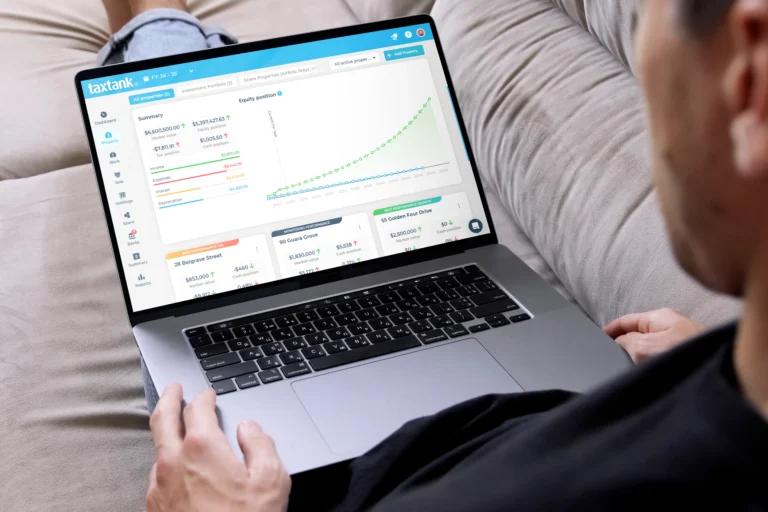
Managing an investment property involves much more than recording rent and expenses.
Loan interest, depreciation, borrowing costs, repairs, ownership percentages, capital improvements, negative gearing and capital gains can all affect your final tax position. If you also earn a salary, operate a sole trader business or own other investments, the complete picture becomes even more complicated.
The right rental property accounting software can help you keep accurate records and reduce the work required at tax time. However, not every platform is built for the same purpose.
Some software is designed for business accounting. Some help landlords manage tenants and maintenance. Other platforms focus on property performance or specialised property tax software that applies Australian tax rules.
This guide compares the main types of rental property accounting software available in Australia and explains which option may best suit your investment strategy.
Rental property accounting software compared
| Software | Best suited to | Starting price* | Main limitation for investors |
|---|---|---|---|
| TaxTank | Australian investors wanting property, tax and portfolio management | $180 per year | Does not manage tenants or lodge tax returns |
| Xero | Businesses already using Xero for accounting | From $37 per month | Not designed to calculate an individual investor’s complete tax position |
| MYOB | Businesses requiring accounting, invoicing or payroll | From $315 per year | Property tax calculations generally require manual setup or accountant input |
| QuickBooks | Small businesses needing cloud accounting | From $29 per month | Primarily designed for business accounting rather than personal property tax |
| Property management software | Self-managing landlords and property managers | Varies | Usually focuses on tenants and rent rather than individual tax |
| Spreadsheet | Investors with basic record-keeping needs | Free or low cost | Requires manual updates, formulas and tax calculations |
*Standard starting prices available in August 2026, excluding temporary introductory offers. Software pricing and inclusions can change.
What should rental property accounting software do?
The best rental property accounting software depends on what you are trying to manage.
If you only need to record rental income and expenses, standard accounting software or a spreadsheet may be enough. If you manage tenants directly, you may need features such as rent collection, lease records, inspections and maintenance requests.
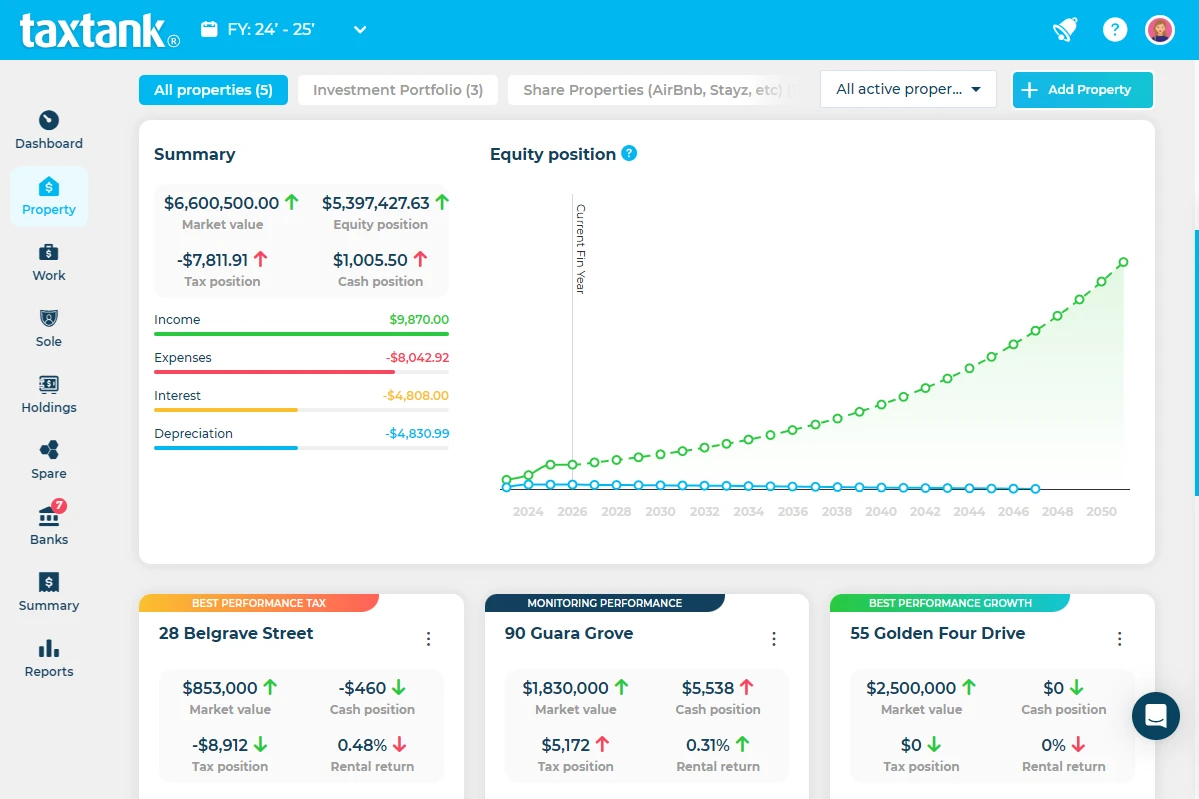
However, property investors who want to understand the tax and financial effect of their portfolio need more than a rental ledger. A dedicated investment property tracker can also provide visibility over cash flow, equity, growth and performance.
Useful rental property accounting software should help you:
- Track rental income and expenses separately for each property
- Import transactions from eligible bank accounts
- Categorise property expenses correctly
- Manage loan interest and borrowing expenses
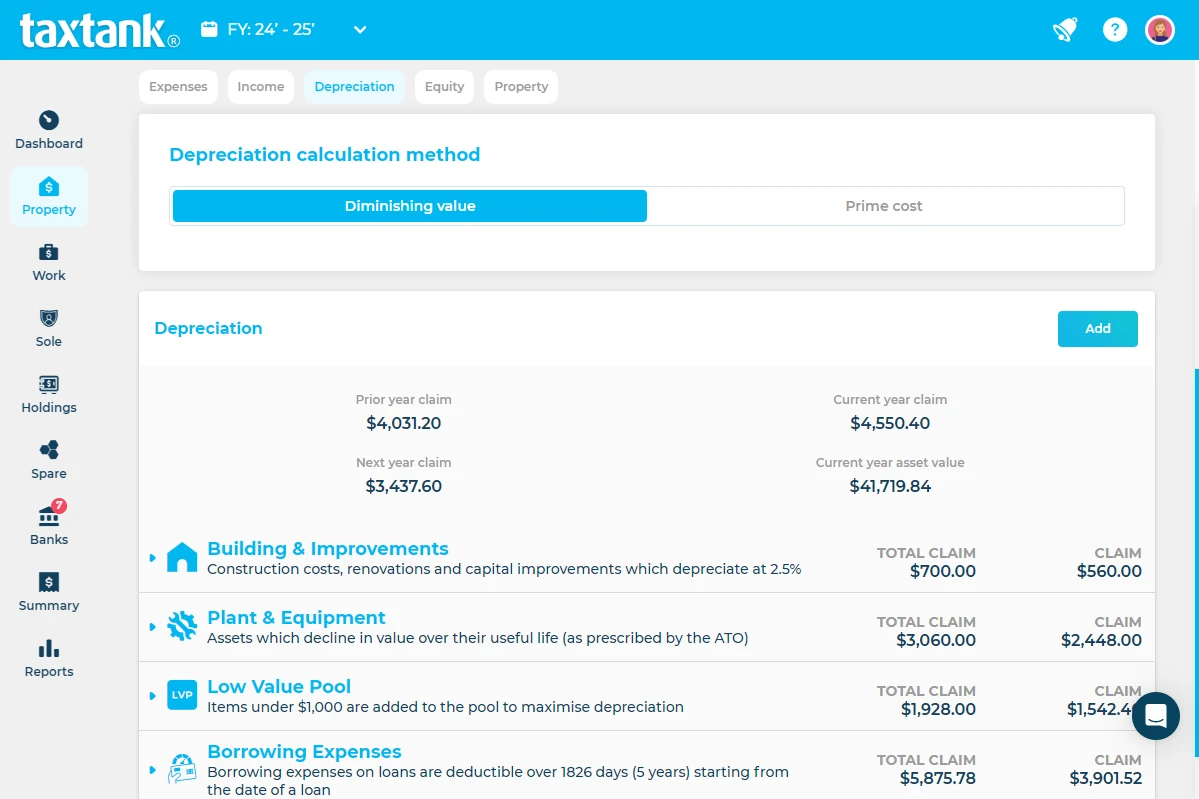
- Track depreciation and capital works
- Record repairs, maintenance and capital improvements
- Apply different property ownership percentages
- Manage short-term or shared accommodation
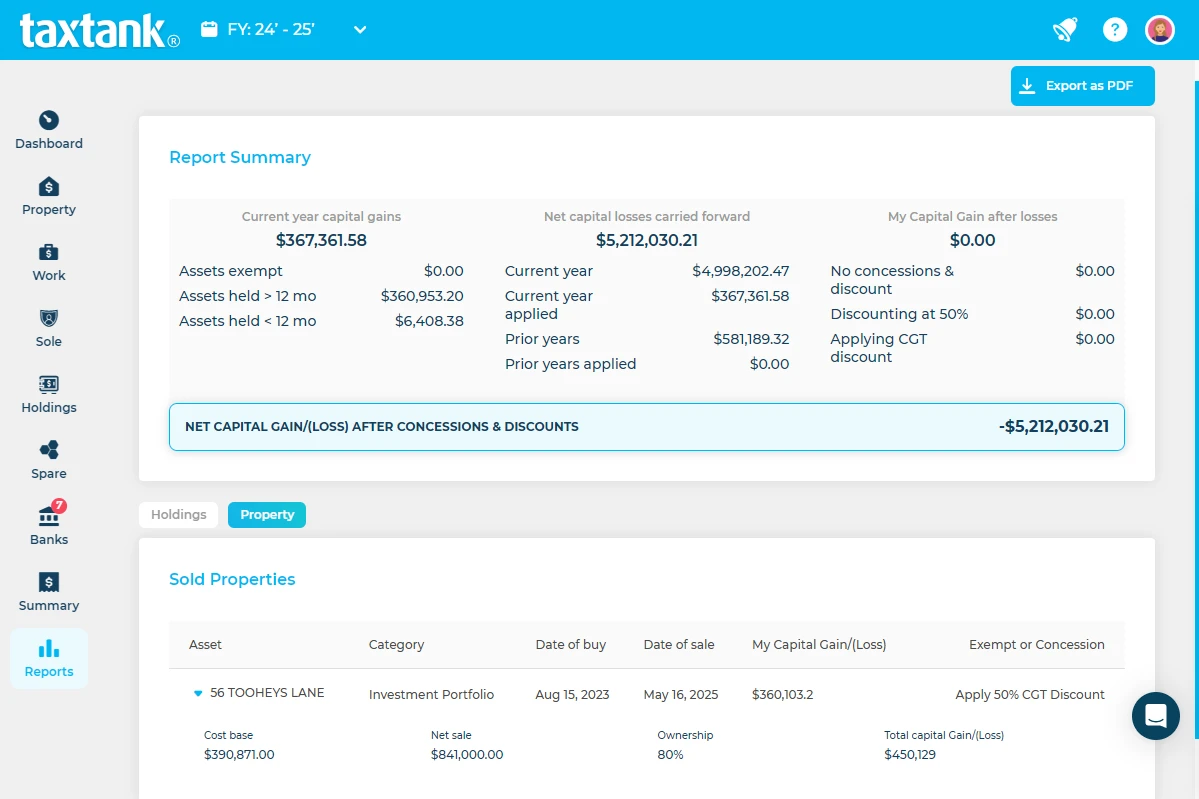
- Calculate live capital gains
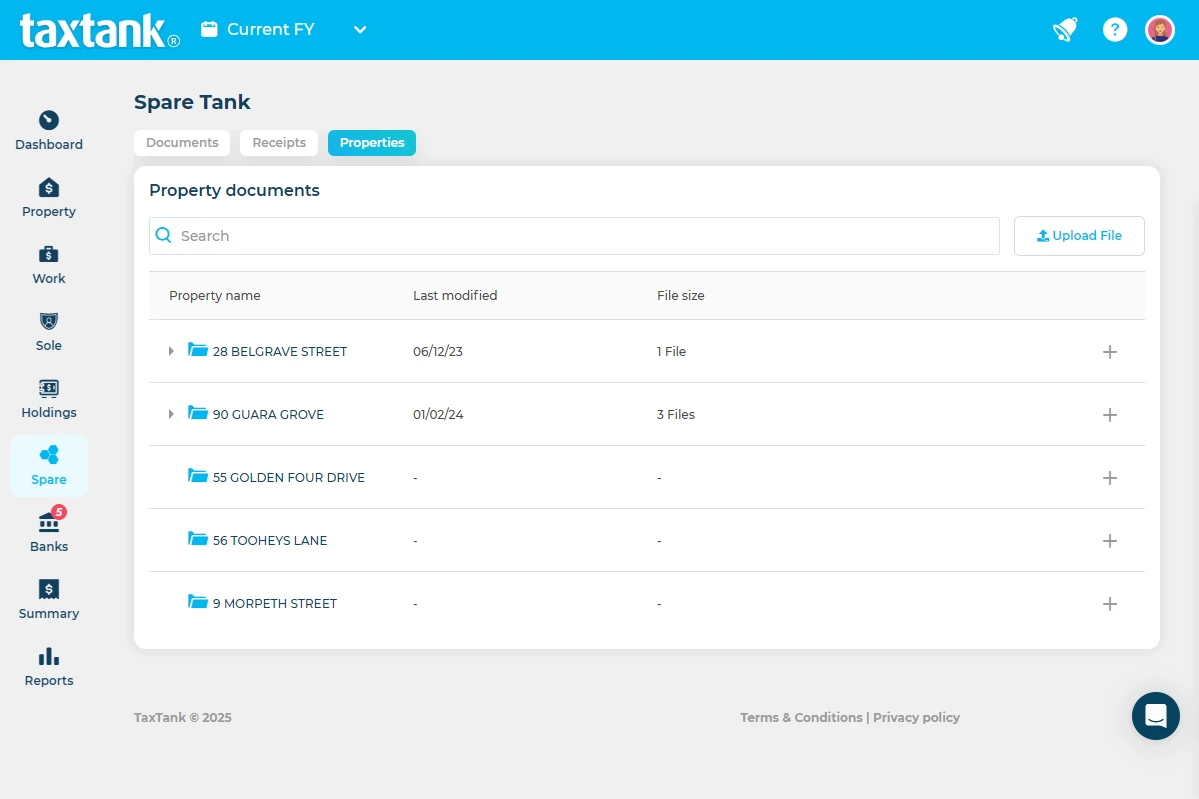
- Store receipts, statements and supporting documents
- Produce reports for your accountant
- See how each property affects your overall tax position
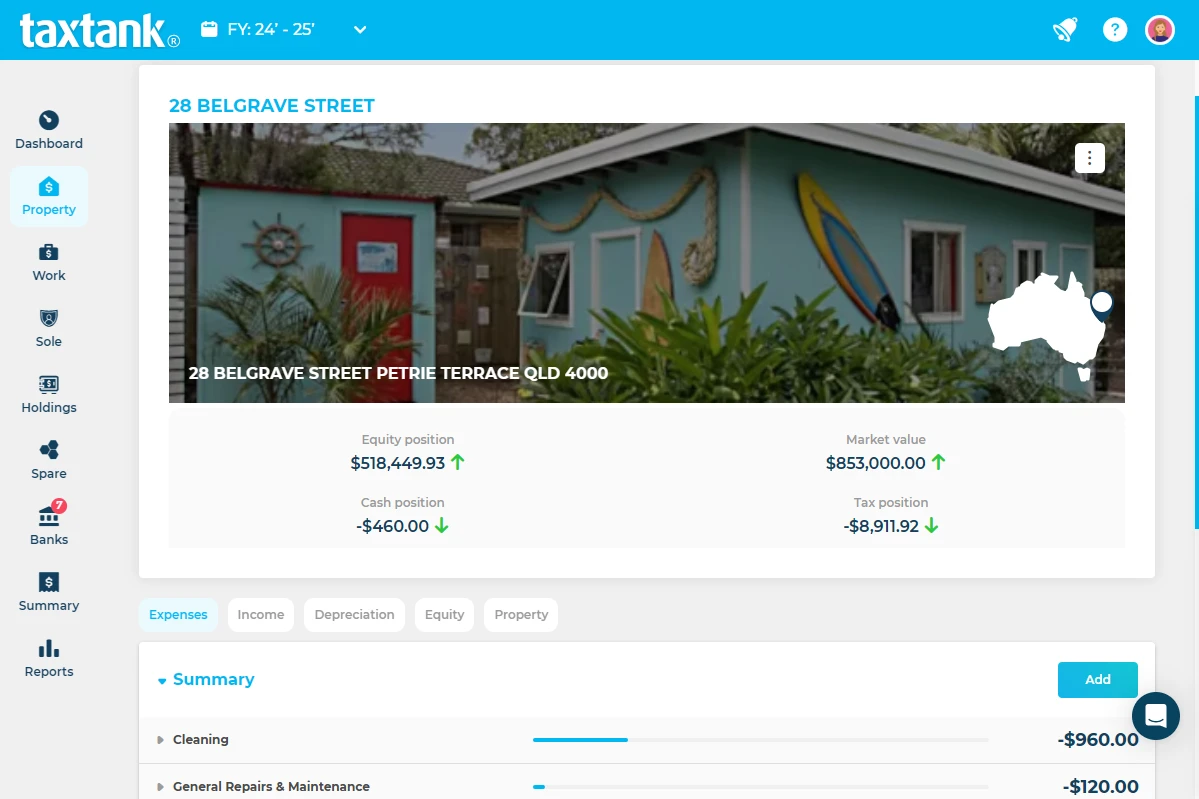
- Monitor property cash flow, equity, growth and performance
The important distinction is whether the software merely records transactions or also calculates what those transactions mean for your tax.
1. TaxTank
Best for Australian property investors who want live tax and portfolio visibility
TaxTank is Australian rental property accounting software designed specifically for individual investors.
Unlike traditional business accounting software, TaxTank brings your investment properties together with your employment income, sole trader income, shares, cryptocurrency and other personal tax information. It then automatically applies Australian tax rules to calculate your overall tax position throughout the year.
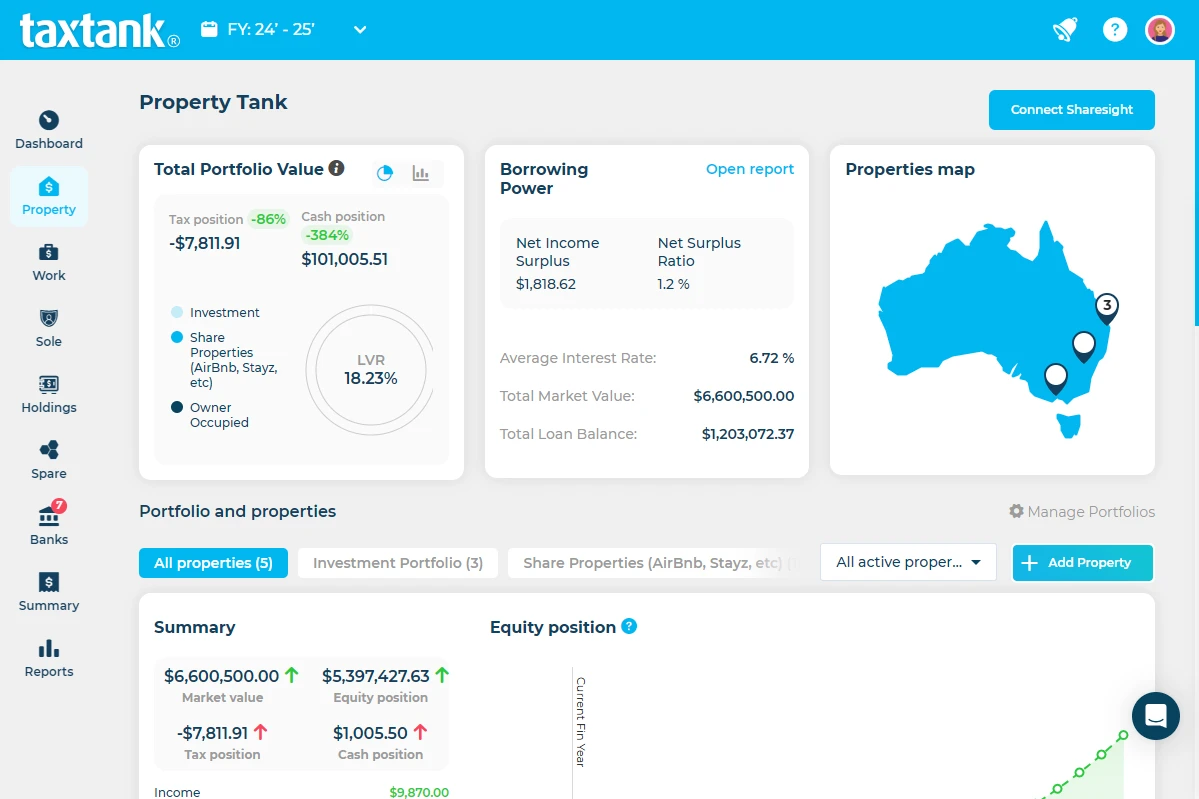
TaxTank’s property portfolio software allows you to manage personally owned and jointly owned investment properties while also creating separate portfolios for properties held in trusts, companies and SMSFs.
Key features
- Secure Open Banking feeds for eligible accounts
- Rental income and expense tracking
- Automated bank rules for recurring transactions
- Property ownership and claim percentages
- Loan interest and borrowing expense management
- Capital works and asset depreciation
- Renovation and capital improvement tracking
- Negative gearing calculations
- Property capital gains tax calculations
- Short-term rental and shared accommodation support
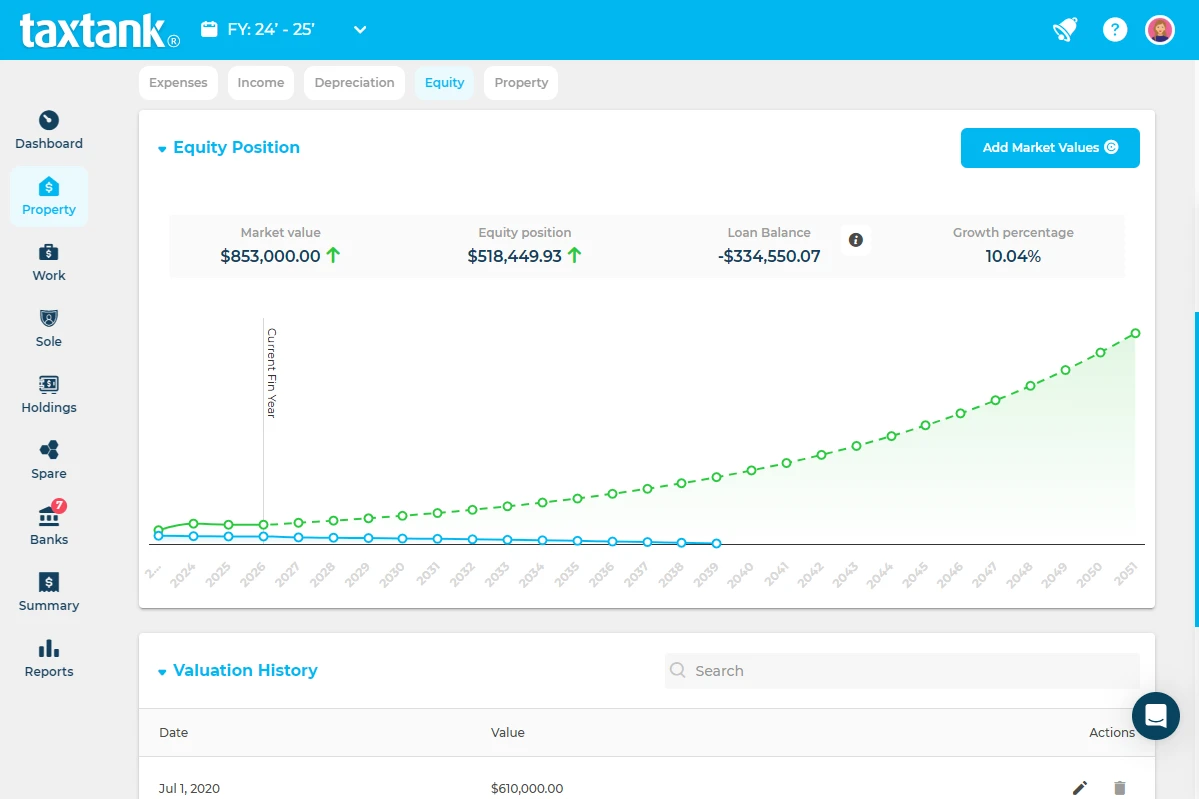
- CoreLogic property values
- Cash flow, equity, growth, yield and LVR tracking
- Receipt and document storage
- Reports for accountants
- Collaboration with co-owners, accountants, brokers and advisers
- Multiple financial years using the relevant rules for each supported year
- AI onboarding support and help (with more to come soon)
Because TaxTank combines property activity with your other income and deductions, it shows how an investment property may affect your individual tax position rather than reporting on the property in isolation.
What TaxTank does not do
TaxTank is not tenant or property management software. It does not advertise vacancies, collect rent from tenants, schedule inspections or manage maintenance requests.
It also does not lodge tax returns. You can use its reports to prepare to self-lodge through myTax, invite your accountant to access your account directly or provide the organised information to them in standard reports your accountant would understand.
Cost
Property Tank costs $15 per month, paid annually for the first five properties. Additional properties cost $3 each per month, paid annually.
Best suited to
- Individual property investors
- Investors with multiple properties
- Joint property owners
- Investors with employment and rental income
- People managing properties across different ownership structures, including Trusts, Companies and SMSFs
- Investors wanting to track and calculate depreciation, negative gearing and CGT
- Anyone replacing an investment property spreadsheet
2. Xero
Best for businesses already using Xero
Xero is one of Australia’s best-known cloud accounting platforms. It includes bank reconciliation, invoicing, expense tracking, GST reporting, payroll and financial reports.
It can be configured to track rental income and expenses using separate accounts, tracking categories or individual organisations. This can work well when a property is held within a company, trust or business structure already using Xero.
However, Xero is business accounting software rather than dedicated property tax software.
It can record rental property transactions, but it does not automatically bring those records together with an individual investor’s salary, work deductions, Medicare levy, HELP debt, shares, cryptocurrency and other personal tax information.
Property-specific calculations such as depreciation, negative gearing and CGT may require separate schedules, apps, spreadsheets or assistance from an accountant.
Key features
- Bank feeds and reconciliation
- Income and expense tracking
- Bills and invoicing
- GST and BAS reporting
- Financial statements
- Accountant and bookkeeper access
- Large integration marketplace
Cost
Australian Xero plans start from $37 per month ($444 per year) at the standard price, with higher plans available for additional accounting, payroll and reporting requirements.
If each property or ownership structure requires a separate Xero organisation, the total cost can increase considerably.
Best suited to
- Companies and trusts already using Xero
- Businesses with employees or payroll
- Investors who need formal business accounting
May not suit
- Individual investors wanting personal tax calculations
- Investors who need built-in property depreciation and CGT tools
- People who do not need invoicing, payroll or broader business accounting
3. MYOB
Best for businesses needing established accounting tools
MYOB provides accounting, invoicing, bank reconciliation, payroll, inventory and financial reporting for Australian businesses.
Like Xero, MYOB can record rental income and property expenses when the accounts and categories are configured correctly. It may suit a company or trust that already uses MYOB for its broader accounting requirements.
Its primary purpose is still business accounting, not calculating the complete personal tax position of an individual property investor.
Property depreciation, ownership apportionment, negative gearing and capital gains may need to be managed through additional records or with assistance from an accountant.
Key features
- Bank account connections
- Income and expense tracking
- Receipt storage
- GST and BAS reporting
- Invoicing
- Payroll options
- Business financial reports
- Accountant access
Cost
MYOB Business Lite has a standard price of $315 per year, excluding temporary introductory offers. More advanced plans cost more and include additional business, payroll and reporting features.
Best suited to
- Small businesses already using MYOB
- Companies or trusts requiring business accounts
- Investors who also need invoicing, payroll or GST reporting
May not suit
- Individual investors seeking property-specific tax calculations
- Investors wanting portfolio performance and personal tax in one platform
- People who would be paying for business features they do not use
4. QuickBooks Online
Best for small businesses wanting accessible cloud accounting
QuickBooks Online is another established accounting platform for small businesses. It includes income and expense tracking, bank connections, invoicing, GST management and financial reporting.
Rental properties can be tracked using classes, locations or separate accounts, depending on the subscription and accounting setup.
QuickBooks can help maintain clean financial records, but it is not built specifically around Australian investment property tax. It generally will not calculate how rental losses, depreciation or a future capital gain affect your complete individual tax position.
Key features
- Bank transaction imports
- Income and expense tracking
- Receipt capture
- Invoicing
- GST tracking
- Profit and loss reports
- Accountant access
- Cloud and mobile access
Cost
QuickBooks Online starts from approximately $29 per month ($348 per year) at its standard Australian price, excluding introductory offers.
Best suited to
- Small businesses already using QuickBooks
- Investors comfortable configuring their own accounting categories
- Entities requiring general business financial reports
May not suit
- Investors wanting dedicated Australian property tax tools
- People who want depreciation, negative gearing and CGT calculations included
- Individual investors without broader business accounting requirements
5. Landlord and property management software
Best for managing tenants, rent and maintenance
Property management software solves a different problem from property accounting software.
Platforms such as RentBetter can help self-managing landlords advertise properties, screen tenants, collect rent, manage leases and organise maintenance. Other systems, including PropertyMe, are primarily designed for real estate agencies and professional property managers.
These tools can be valuable if you manage the day-to-day relationship with tenants yourself.
However, managing a tenancy is not the same as managing your individual tax position. Property management software may record rental transactions and produce owner statements, but it will not necessarily calculate:
- Property depreciation
- Borrowing expense deductions
- Negative gearing against your other income
- Capital gains tax
- Your complete personal tax position
- Tax effects across multiple types of investments
Many investors use property management software or a managing agent alongside separate tax software.
Best suited to
- Self-managing landlords
- Property managers and real estate agencies
- Investors needing tenant communication and maintenance tools
- Landlords wanting rental payment and lease management
May not suit
- Investors whose main priority is tax
- People using a professional property manager already
- Investors wanting a complete view across salary, property and investments
6. Investment property spreadsheets
Best for simple record keeping with a very limited budget
A free investment property spreadsheet can be a reasonable starting point for someone with one uncomplicated rental property.
It allows you to create categories for rent, interest, repairs, insurance, rates and other expenses without paying for software. You also retain control over the format and calculations.
The limitation is that a spreadsheet only does what you build it to do.
It does not automatically import transactions, store receipts against individual entries or update itself when Australian tax rules change. Depreciation, ownership percentages, capital works, borrowing expenses and CGT calculations must all be created and maintained manually.
As a portfolio grows, so does the risk of inconsistent categories, broken formulas, missed expenses and information being stored across multiple files.
Best suited to
- Investors with one simple property
- People who enjoy maintaining spreadsheets
- Basic income and expense tracking
- Investors who have an accountant completing all tax calculations
May not suit
- Multi-property portfolios
- Jointly owned properties with changing use
- Investors wanting live tax calculations
- Properties involving renovations, depreciation or future CGT
- People who want automatic transaction imports
Rental property accounting software and property management software are not the same
These terms are often used interchangeably, but they describe different types of software.
| Type of software | Primary purpose |
|---|---|
| Business accounting software | Record business transactions and produce financial reports |
| Property management software | Manage tenants, rent, leases, inspections and maintenance |
| Property portfolio software | Monitor property values, equity, yields and performance |
| Property tax software | Apply property tax rules and calculate deductions and tax outcomes |
| Rental property accounting software | Organise rental finances, reporting and property-related records |
Some platforms cover more than one category, but very few cover all of them.
Before choosing software, decide whether your priority is managing tenants, producing business accounts, tracking portfolio performance or understanding your property tax position.
Which rental property accounting software is best for you?
Choose TaxTank if:
- You own property as an individual or joint owner
- You want to see how property affects your complete tax position
- You need depreciation, negative gearing and CGT calculations
- You want to manage multiple properties and ownership structures
- You want property performance and tax information together
- You are replacing spreadsheets
Choose Xero, MYOB or QuickBooks if:
- Your property is operated through a business requiring formal accounts
- You need payroll, invoicing or business financial statements
- Property-specific tax calculations will be handled separately
Choose landlord software if:
- You manage your own tenants
- You need rental advertising, leases and inspections
- You want to collect rent or manage maintenance online
- Tax calculations are handled through another platform
Choose a spreadsheet if:
- Your property affairs are uncomplicated
- You are comfortable maintaining formulas and records manually
- You only need basic income and expense tracking
- Your accountant handles the complex calculations
Why property investors need more than bookkeeping
The Australian Taxation Office’s rental property guidance explains that investors need to keep records, declare rental income and determine which expenses can be claimed immediately or over time.
Bookkeeping records what happened. Property tax calculations explain what it means.
A loan repayment, for example, cannot simply be treated as one deductible expense. The interest component may be deductible, while the principal repayment generally is not.
A renovation may need to be treated as capital works rather than an immediate repair. Understanding the treatment of different property tax deductions is essential because recording an expense does not automatically make it immediately deductible. Borrowing expenses may need to be claimed over several years. Some costs cannot be deducted now but may form part of the property’s CGT cost base.
Ownership, private use, rental availability and the date an expense was incurred can also change its tax treatment.
This is why generic transaction tracking does not always give property investors the answer they actually need. Recording the amount is only the first step. Applying the correct tax treatment determines the outcome.
The best option for Australian property investors
There is no single platform that will be right for every landlord.
Xero, MYOB and QuickBooks are strong choices for business accounting. Property management platforms are better for managing tenants and leases. Spreadsheets can work for basic record keeping.
TaxTank is designed for property investors who want to understand both their portfolio and their tax position throughout the year.
It brings rental income, property expenses, depreciation, loans, capital improvements, ownership details and CGT records together while also accounting for employment income, sole trader activity and other investments.
That means you are not simply looking at whether a property made a profit or loss. You can see how that result may affect your complete live tax position.
Frequently asked questions
What is the best rental property accounting software in Australia?
TaxTank is the best rental property accounting software in Australia for investors who want purpose built property accounting with every feature you need. Property Tank brings rental income, expenses, depreciation, ownership splits, loans, equity and capital gains calculations together. With the relevant Tanks, it also includes employment income, sole trader income and other investments, so you can see how your properties affect your overall tax position.
Can I use Xero for a rental property?
Yes. Xero can record rental income and expenses when it is configured correctly.
However, Xero is business accounting software and does not automatically calculate an individual investor’s complete Australian tax position. Property depreciation, negative gearing, ownership percentages and CGT may require additional tools or accountant input.
Do I need separate rental property accounting software for each property?
Not necessarily.
TaxTank allows multiple properties to be managed within one Property Tank subscription, with income, expenses, loans, documents and performance separated for each property.
Some business accounting platforms may require separate organisations or carefully configured tracking categories, particularly where properties are held through different legal entities.
Can rental property accounting software calculate depreciation?
Some specialist platforms can.
TaxTank includes tools for managing eligible plant and equipment, capital works and renovation schedules. Traditional accounting software generally records depreciation entries after they have been calculated elsewhere.
Can property accounting software calculate negative gearing?
TaxTank calculates how eligible rental property income and deductions may affect taxable income and your live overall tax position.
Many accounting platforms can show that a property produced an accounting loss, but they do not necessarily apply the individual tax rules required to calculate your personal negative gearing outcome.
Can I track jointly owned rental properties?
Yes. TaxTank allows ownership and claim percentages to be recorded so that eligible income and expenses can be apportioned to the relevant owner.
You can also invite a property co-owner to collaborate on the property records.
Does rental property accounting software replace an accountant?
Not necessarily.
Software can organise records, automate calculations and reduce manual work. An accountant can provide personal advice, review complex circumstances and prepare or lodge your tax return.
TaxTank allows you to invite your accountant and provide access to your organised, up-to-date information.
Can I use property accounting software for Airbnb or short-term rentals?
Yes, provided the software supports different rental and private-use percentages.
TaxTank allows investors to manage share accommodation and short-term rental arrangements, including claim percentages that reflect how the property has been used.
How much does TaxTank’s Property Tank cost?
Property Tank costs $180 per year and includes up to five properties.
Additional properties can be added for $36 each per year. You can try TaxTank free for 14 days without entering a credit card.
Stop managing property tax in hindsight
Your property’s tax position changes throughout the year as rent is received, interest is charged, expenses are incurred and improvements are completed.
Waiting until tax time means trying to reconstruct those decisions after the opportunity to manage them has passed.
TaxTank gives Australian property investors a clearer view throughout the year by bringing property records, tax calculations and portfolio performance together in one place.