

Table of Contents
Last updated: August 2026 following the introduction of Australia’s new $1,000 standard deduction.
Working from home can come with valuable tax deductions if you know what you’re entitled to claim. With the ATO tightening record-keeping requirements and the Australian Government introducing a new $1,000 standard work-related deduction from 1 July 2026, understanding which option gives you the best result is more important than ever.
According to the Australian Bureau of Statistics, 36% of employed Australians usually work from home. With more than one in three workers now regularly working remotely, understanding what you can claim and how to keep the right records has become an important part of managing your tax effectively.
Whether you’re a hybrid employee, full-time remote worker or sole trader, this guide explains what you can claim, the different deduction methods available, and how TaxTank automatically helps you maximise your work from home deduction while staying ATO compliant.
What’s New for Work From Home Deductions in 2026?
One of the biggest changes to Australian tax this financial year is the introduction of the new $1,000 standard deduction for eligible work-related expenses.
From 1 July 2026, eligible taxpayers can choose to claim a $1,000 standard deduction instead of individually claiming certain work-related expenses. The change is designed to simplify tax for millions of Australians, particularly employees with relatively modest work-related expenses.
However, while the new standard deduction makes claiming easier, it won’t necessarily result in the largest tax deduction for everyone.
If your eligible work-related expenses are more than $1,000, you can still choose to claim your actual deductions instead. This means it’s important to compare your options before lodging your tax return rather than automatically choosing the standard deduction.
For people who regularly work from home, the best option will depend on factors such as:
- How many hours you work from home
- Your internet and phone costs
- Electricity and heating or cooling expenses
- The cost of your home office equipment
- Whether you’ve purchased items such as a laptop, monitor, desk or office chair
- Whether you’re eligible to claim depreciation on work-related assets
For many hybrid workers and full-time remote employees, work from home deductions alone may exceed $1,000, particularly if they’ve purchased new equipment during the financial year. In these situations, claiming your actual work-related expenses may produce a larger tax deduction than taking the standard deduction.
The same applies to sole traders and business owners working from home. Depending on how your home office is used, you may be entitled to claim additional running or occupancy expenses that aren’t replaced by the standard deduction. Understanding which rules apply to your situation can make a significant difference to your overall tax outcome.
The challenge is that calculating and comparing these different methods can quickly become complicated. Many taxpayers don’t know whether they’re better off claiming the $1,000 standard deduction or keeping records and claiming their actual work from home deductions instead.
The challenge is knowing which method gives you the best result. That’s where TaxTank helps.
Rather than making you calculate everything manually, TaxTank records your work-related expenses throughout the year, tracks your work from home hours using the Home Office Diary, stores your receipts and applies the current Australian tax rules automatically. It then compares your available deduction methods so you can see which approach delivers the best result for your circumstances.
Whether the $1,000 standard deduction is enough or your actual work from home deductions are worth more, you’ll have confidence that you’re choosing the option that maximises your tax position while remaining fully compliant with Australian tax rules.
What Counts as Working From Home?
To claim work from home deductions, you must be genuinely working from home to earn income. This includes:
- Full-time remote workers
- Hybrid employees with regular work-from-home days
- Sole traders and freelancers running a business from home
- Casuals or part-timers doing admin tasks or emails from home
Simply checking emails after hours or occasionally taking a work call from home generally isn’t enough. You must be performing income-producing work from home on a regular basis and keep the records required under the method you choose.
What Work from Home Deductions Can You Claim?
The work from home deductions you can claim depend on your circumstances, whether you’re an employee or sole trader, and the method you choose to calculate your claim.
Generally, work from home expenses fall into two categories.
1. Running Expenses
Running expenses are the day-to-day costs of using your home to earn income. Depending on your situation and claim method, these may include:
- Electricity and gas for heating, cooling and lighting
- Home internet costs
- Mobile and landline phone expenses used for work
- Home office equipment and depreciation
- Cleaning costs for a dedicated work area
- Stationery and office consumables
2. Occupancy Expenses (Sole Traders Only)
If your home is your principal place of business as a sole trader, you may also be able to claim a portion of your occupancy expenses, including:
- Rent or mortgage interest
- Council rates
- Home insurance premiums
- Land tax (where applicable)
Important: Employees can’t claim occupancy expenses, even if they work from home full time. These deductions are generally only available where your home is your principal place of business.
Common Work From Home Expenses
Many people search for whether they can claim specific items they’ve purchased for their home office. Depending on your circumstances and the claim method you use, you may be able to claim:
- Laptop used for work
- Monitor or second screen
- Standing desk
- Office chair
- Keyboard and mouse
- Printer
- Printer ink and paper
- Electricity and gas used while working from home
- Home internet
- Mobile phone used for work
- Cleaning costs for a dedicated home office
- Stationery and office supplies
Some of these expenses may be included in the Fixed Rate Method, while others, such as eligible depreciating assets including laptops, monitors and office furniture, may still be claimed separately. If you’re using the Actual Cost Method, you’ll generally claim the work-related portion of your actual expenses based on your records.
TaxTank records your work-related expenses throughout the year, stores your receipts, tracks your work from home hours and compares the available claim methods, helping you maximise your work from home deductions while staying compliant with Australian tax rules.
Which Method Could Give You the Biggest Deduction?
The right claiming method depends on your individual circumstances, your work-related expenses and the records you’ve kept throughout the financial year. While the new $1,000 standard deduction may be the simplest option for some taxpayers, others may achieve a larger deduction by claiming their actual work-related expenses instead.
Here’s how the different methods may apply in common situations.
| Your situation | Methods worth considering |
|---|---|
| Smaller work-related expense claims | $1,000 Standard Deduction or Actual Cost Method |
| Regular hybrid worker | $1,000 Standard Deduction, Fixed Rate Method or Actual Cost Method |
| Full-time remote worker | Fixed Rate Method or Actual Cost Method |
| Significant home office equipment purchases | Actual Cost Method |
| Sole trader working from home | Actual Cost Method and, where eligible, the Occupancy Method |
The only way to know which method provides the best outcome is to compare the available options based on your own circumstances.
That’s where TaxTank’s live work from home tax calculator makes things simple. Instead of manually calculating different claim methods, TaxTank records your work from home hours, tracks your work-related expenses, stores your receipts and compares the available deduction methods for you. That means you can confidently choose the approach that delivers the best result while remaining compliant with Australian tax rules.
Understanding the Different Claim Methods
There are several ways to claim work-related expenses, and the method that gives you the best outcome will depend on your individual circumstances, the expenses you’ve incurred and the records you’ve kept throughout the year.
| Feature | $1,000 Standard Deduction | Fixed Rate Method | Actual Cost Method |
|---|---|---|---|
| Simple to claim | ✓ | ✓ | ○ |
| Detailed record keeping | Minimal | Required | Most extensive |
| Work from home hours required | Depends on the legislation | ✓ | May be required |
| Actual electricity costs | Included | Included | ✓ |
| Actual internet costs | Included | Included | ✓ |
| Home office equipment | Depends on the legislation | Eligible items may be claimed separately | ✓ |
| Best suited to | Taxpayers with lower eligible work-related expenses | Taxpayers wanting a simple hourly calculation | Taxpayers with higher eligible work-related expenses |
The best method depends on your individual circumstances. TaxTank compares the available claim methods automatically, helping you determine which approach may provide the best outcome based on your work-related expenses and records.
1. $1,000 Standard Deduction
From 1 July 2026, eligible taxpayers can choose to claim the new $1,000 standard deduction for eligible work-related expenses instead of claiming those expenses individually.
The standard deduction is designed to simplify tax for employees with lower work-related expenses, as it removes the need to keep receipts for eligible expenses up to the deduction amount. However, if your eligible work-related expenses exceed $1,000, you can choose to claim your actual deductions instead if that results in a better outcome.
2. Fixed Rate Method (70 cents per hour)
The Fixed Rate Method allows you to claim 70 cents for every hour you work from home.
The hourly rate includes:
- Electricity and gas
- Internet and phone expenses
- Stationery and computer consumables
Because these expenses are included in the hourly rate, you can’t claim them separately. You must also keep a record of the actual hours you worked from home, as estimates aren’t accepted by the ATO.
Eligible depreciating assets, such as laptops, monitors and office chairs, may still be claimed separately where permitted.
3. Actual Cost Method
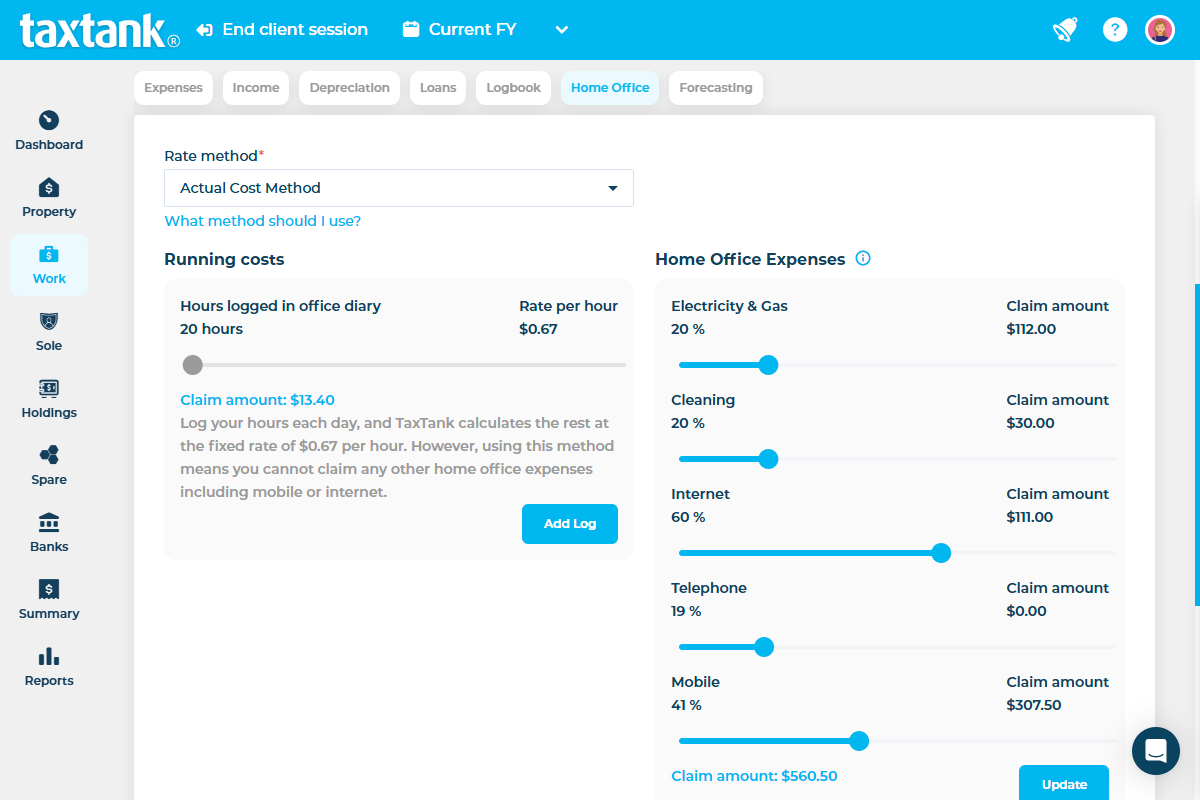
The Actual Cost Method allows you to claim the work-related portion of your actual home office expenses.
These may include:
- Electricity and gas for heating, cooling and lighting
- Home internet and data costs
- Mobile and home phone expenses
- Stationery and printer consumables
- Cleaning costs for a dedicated home office
- Depreciation on eligible home office equipment
This method generally requires more detailed records, including receipts and evidence of how you’ve calculated the work-related portion of each expense.
4. Occupancy Method (Sole Traders Only)
If you’re a sole trader and your home is your principal place of business, you may also be able to claim occupancy expenses in addition to your running expenses.
These may include:
- Mortgage interest or rent
- Council rates
- Land tax (where applicable)
- Home insurance
You can also claim your eligible running expenses, including:
- Electricity and gas
- Home internet
- Mobile and phone expenses
- Stationery and office consumables
- Cleaning costs for your dedicated work area
Because the rules differ depending on your circumstances, keeping accurate records throughout the year is essential. TaxTank automatically tracks your work from home expenses, records your hours, stores your receipts and compares the available claim methods, helping you maximise your deduction while remaining compliant with Australian tax rules.
What Records Do You Need to Keep?
The records you’ll need depend on the method you choose to claim your work from home deductions. While the $1,000 standard deduction simplifies the claiming process for many taxpayers, the Fixed Rate Method, Actual Cost Method and Occupancy Method all require accurate record keeping to support your claim.
Depending on your claim method, you may need to keep:
- A record of the hours you worked from home.
- Receipts or invoices for work-related purchases.
- Evidence showing how you calculated the work-related portion of shared expenses, such as your internet or mobile phone bill.
- Records for depreciating assets, including laptops, monitors and office furniture.
Keeping these records throughout the financial year is much easier than trying to recreate them at tax time.
Track Your Work From Home Deductions with TaxTank’s Home Office Diary
TaxTank includes Australia’s first digital Home Office Diary, purpose-built to help you manage your work from home deductions all year round.
With TaxTank you can:
- Record your work from home hours as they happen.
- Automatically calculate and apportion eligible work-related expenses.
- Allocate expenses directly from your connected bank feeds.
- Attach receipts and supporting documents to every transaction.
- Compare the available claim methods to determine which gives you the best outcome.
- Keep your records organised and ready if you ever need to substantiate your claim.
Instead of relying on spreadsheets or trying to gather receipts at the end of the financial year, TaxTank keeps everything in one secure place, making it easier to maximise your work from home deductions while remaining compliant with Australian tax rules.
Real Examples of Work From Home Deductions
Every taxpayer’s situation is different, which is why there’s no single claiming method that’s right for everyone. The best approach to track your work-related expenses depends on your work from home arrangements and the records you’ve kept throughout the financial year.

Example 1: Hybrid Employee
Emma works from home three days a week and from the office the other two. Throughout the year, she records her work from home hours in TaxTank’s Home Office Diary and allocates her electricity, internet and phone expenses directly from her connected bank feeds.
At tax time, TaxTank compares the available claim methods and shows her which option provides the best outcome based on her circumstances.
Example 2: Full-Time Remote Worker
James works from home five days a week and recently purchased a new laptop, monitor and ergonomic office chair. TaxTank stores his receipts, tracks his depreciating assets and helps him compare the available claim methods to determine which one gives him the largest eligible deduction.


Example 3: Sole Trader
Sarah runs her consulting business from a dedicated home office. Throughout the year, she records her running expenses, allocates business transactions from her bank feeds and tracks her home office costs. TaxTank helps calculate her eligible running and occupancy expenses, keeping everything organised and ready for tax time.
Rather than trying to work everything out manually, each taxpayer can compare the available claim methods and confidently choose the one that best suits their circumstances.
What You Can’t Claim
While there are plenty of legitimate work from home deductions available, there are also expenses that generally can’t be claimed.
These include:
- Coffee, tea and snacks
- Childcare costs while working from home
- Rent or mortgage interest if you’re an employee
- Private internet or phone usage
- Personal household expenses unrelated to your work
- Expenses that have been reimbursed by your employer
- Expenses without the required records or supporting evidence (where applicable)
Common Work From Home Deduction Mistakes
Avoiding these common mistakes can help ensure your claim remains accurate and ATO compliant.
- Guessing your work from home hours instead of keeping proper records.
- Claiming 100% of shared expenses such as internet or phone bills when only part relates to work.
- Claiming occupancy expenses as an employee.
- Forgetting to keep receipts for eligible purchases.
- Relying on the old 80 cents per hour COVID shortcut method, which is no longer available.
- Not comparing the available claim methods to determine which gives you the best outcome.
Why Australians Use TaxTank for Work From Home Deductions
Keeping track of work from home deductions manually can quickly become time consuming, especially if you’re switching between spreadsheets, receipts and bank statements.
TaxTank brings everything together in one place, from your bank transactions and receipts to your Home Office Diary and tax calculations.
| Manual Tracking | TaxTank |
|---|---|
| Spreadsheets and manual calculations | Live Home Office Diary with automatic calculations |
| Paper receipts | Digital receipt storage linked to transactions |
| Manual expense allocation | Bank feeds with transaction allocation |
| Comparing claim methods yourself | Compare available claim methods automatically |
| Searching for records at tax time | Everything organised in one place all year round |
Whether you’re claiming the $1,000 standard deduction, the Fixed Rate Method, the Actual Cost Method or managing a home-based business, TaxTank helps you keep accurate records throughout the year and makes tax time significantly easier.
Why Accurate Records Will Matter Even More From 1 July 2027
Keeping accurate records is becoming increasingly important as Australia’s tax rules become more detailed and, in some cases, depend on when an asset was purchased or how it is used.
For people who work from home, the immediate decision may be whether to use the $1,000 standard deduction, the Fixed Rate Method or the Actual Cost Method. However, your work arrangement may be only one part of your overall tax position.
From 1 July 2027, property investors may also need to manage different negative gearing, capital gains tax and depreciation rules depending on when each property was purchased, whether existing arrangements are grandfathered and how the property has been used over time.
This can create multiple layers of tax treatment within the same return. Someone may need to track their work from home hours and expenses while also maintaining separate records for rental income, property expenses, depreciating assets, capital improvements and changes in use.
Spreadsheets can become difficult to manage when the correct tax treatment varies by financial year, property, asset or transaction. A single missing receipt, incorrect date or poorly recorded change in use may affect how an expense or capital gain is calculated later.
Starting with accurate digital records now can make future tax years much easier. By keeping transactions, receipts, work from home hours and asset details organised as they occur, you reduce the need to reconstruct years of information when an asset is sold or your circumstances change.
TaxTank brings these records together and applies the relevant Australian tax rules across your employment, sole trader, investment and property activities. This gives you a clearer view of your overall tax position and helps ensure the right rules are applied to each income type, expense and asset.
Final Word
Work from home deductions can make a meaningful difference to your tax return, but only if you’re claiming the right expenses, keeping the right records and using the claim method that best suits your circumstances.
With the introduction of the $1,000 standard deduction, claiming work-related expenses has become simpler for many Australians. However, depending on your situation, claiming your actual work-related expenses may still provide a larger deduction.
By keeping accurate records throughout the year and comparing the available claim methods, you can lodge your tax return with confidence, knowing you’ve claimed everything you’re entitled to.
Start your free TaxTank trial today and discover a smarter way to manage your work from home deductions.
FAQs
Who can claim work from home deductions in Australia?
You may be able to claim work from home deductions if you’re genuinely working from home to earn income. This includes full-time remote workers, hybrid employees, sole traders, freelancers, and part-time or casual employees who regularly perform work-related duties from home. Simply checking emails or taking the occasional work call from home generally isn’t enough to qualify.
What work from home expenses can I claim?
Depending on your circumstances and the claim method you choose, you may be able to claim:
• Electricity and gas
• Internet and mobile phone expenses
• Stationery and office consumables
• Cleaning costs for a dedicated home office
• Depreciation on laptops, monitors, office chairs, desks and other eligible equipment
• Occupancy expenses (sole traders only, where eligible)
Can I claim a laptop when working from home?
Yes, if you purchased a laptop for work purposes, you may be able to claim its decline in value (depreciation) or, in some cases, an immediate deduction if it meets the relevant tax rules. If the laptop is used for both work and personal purposes, you can generally only claim the work-related portion.
Can I claim a monitor or office chair?
Yes. Home office equipment such as monitors, office chairs, standing desks, keyboards and other work-related equipment may be claimable if they’re used to earn your income. Depending on the item and its cost, the deduction may be claimed immediately or over several years through depreciation.
Can I claim my internet and electricity?
Yes. If you’re using the Actual Cost Method, you may be able to claim the work-related portion of your internet, electricity and gas costs. If you’re using the Fixed Rate Method, these expenses are generally included within the hourly rate and can’t be claimed separately.
Can employees claim rent or mortgage interest?
No. Employees generally can’t claim rent, mortgage interest, council rates or home insurance simply because they work from home. These occupancy expenses are typically only available to sole traders whose home is their principal place of business.
What is the $1,000 standard deduction?
From 1 July 2026, eligible taxpayers can choose to claim the new $1,000 standard deduction for eligible work-related expenses instead of claiming those expenses individually. While this simplifies tax for many Australians, it won’t necessarily provide the largest deduction. If your eligible work-related expenses exceed $1,000, claiming your actual expenses may result in a better outcome.
What methods are available for claiming work from home deductions?
Depending on your circumstances, you may be able to use:
• The $1,000 Standard Deduction
• The Fixed Rate Method (70 cents per hour)
• The Actual Cost Method
• The Occupancy Method (sole traders only)
The most suitable method depends on your individual circumstances and the expenses you’ve incurred throughout the financial year.
Is the Fixed Rate Method or Actual Cost Method better?
There isn’t a single method that’s best for everyone. The Fixed Rate Method is generally simpler, while the Actual Cost Method may provide a larger deduction for taxpayers with higher work-related expenses. The best approach depends on your circumstances, which is why TaxTank compares the available claim methods for you.
Do I need to keep receipts?
If you’re claiming your actual work-related expenses, you’ll generally need to keep receipts, invoices and other supporting documentation. You may also need records showing how you’ve worked out the work-related portion of shared expenses, such as internet or mobile phone bills.
Do I need to keep a record of my work from home hours?
Yes. Depending on the claim method you’re using, you may need to keep an accurate record of the hours you worked from home. Guessing or estimating your hours isn’t accepted where actual records are required.
Can I estimate my hours or use the old COVID shortcut method?
No. The temporary 80 cents per hour COVID shortcut method ended in 2022. Where required, you must keep records of the actual hours you worked from home rather than relying on estimates or sample periods.
What can’t I claim as a work from home deduction?
You generally can’t claim:
• Coffee, tea or snacks
• Childcare costs while working from home
• Private internet or phone usage
• Rent or mortgage interest if you’re an employee
• Expenses reimbursed by your employer
• Expenses that aren’t supported by the required records
What happens if I don’t keep proper records?
If you’re unable to substantiate your claim, the ATO may reduce or deny your deduction. Keeping accurate records throughout the year makes it much easier to support your claim if you’re ever asked to provide evidence.
How does TaxTank help with work from home deductions?
TaxTank includes Australia’s first digital Home Office Diary, allowing you to record your work from home hours, allocate expenses directly from your bank feeds, store receipts, calculate work-related percentages and compare the available claim methods. Instead of relying on spreadsheets, everything is organised in one place and ready for tax time.
Does TaxTank compare the different claim methods?
Yes. TaxTank compares the available claim methods based on the information you’ve recorded, making it easy to see which approach may provide the best outcome for your circumstances while keeping your records organised throughout the year.