

You may be able to reduce capital gains tax when selling property by including eligible costs in your cost base, applying available exemptions and discounts, using capital losses and planning the timing of your sale.
The right approach depends on how you have used the property, how long you have owned it and your overall tax position. With changes to Australia’s CGT rules announced for 1 July 2027, understanding which rules apply to your gain is also becoming more important.
What changes to capital gains tax from 1 July 2027?
From 1 July 2027, Australia’s capital gains tax rules will replace the 50% CGT discount with inflation-based arrangements and introduce a minimum 30% tax rate on gains accruing from that date.
Gains accrued before 1 July 2027 will retain their treatment under the existing rules. A property owned across the changeover may therefore have different CGT treatment for gains accrued before and after that date.
Investors in eligible new-build properties will be able to choose between the existing 50% discount and the new arrangements.
If you want to reduce capital gains tax, understanding these rules and keeping accurate purchase, cost-base and valuation records will be essential.
Understanding Capital Gains Tax on Property
What is Capital Gains Tax (CGT)?
Capital gains tax is essentially a tax on the profit (or “capital gain”) made when you sell an asset for more than its purchase price. In Australia, CGT applies to most properties unless specifically exempt.
How is CGT Calculated?
To calculate your capital gain, you’ll need to consider:
- The original purchase price of the property.
- Acquisition costs, such as stamp duty, buyer’s agent fees, and legal fees.
- The final sale price of the property.
- Depreciation adjustments, which may impact your cost base.
- Sale-related costs, such as agent commissions and legal fees.
For example, if you bought an investment property for $500,000 and sold it for $700,000, your $200,000 profit, adjusted for depreciation claims and eligible costs like stamp duty, agent fees, and legal expenses, would be subject to Capital Gains Tax (CGT).
Types of Property Subject to CGT
Not all properties are treated equally under CGT laws. While your primary residence is typically exempt, investment properties, holiday homes, and other secondary properties fall under CGT rules.
Top Strategies to Reduce Capital Gains Tax
1. Leverage the Main Residence Exemption
If the property you’re selling has been your primary residence, you may qualify for a full CGT exemption. To maximise this benefit, ensure the property consistently met the criteria for being your main residence, and maintain accurate records to support your claim.
2. Use the 50% CGT Discount
Under the current rules, eligible Australian resident individuals can generally reduce their taxable capital gain by 50% after holding an asset for at least 12 months. This reduces the gain included in your taxable income, rather than automatically halving your tax bill. The announced changes from 1 July 2027 mean this strategy needs to be considered alongside the transitional rules.
3. Apply the Six Year Rule
If you move out of your home and rent it out, you may be able to continue treating it as your main residence for CGT purposes for up to six years during an absence. Eligibility depends on your circumstances, and you generally cannot treat another property as your main residence for the same period, apart from limited exceptions. This rule does not automatically apply to a property that has always been an investment.
4. Include Eligible Costs in Your Property’s Cost Base
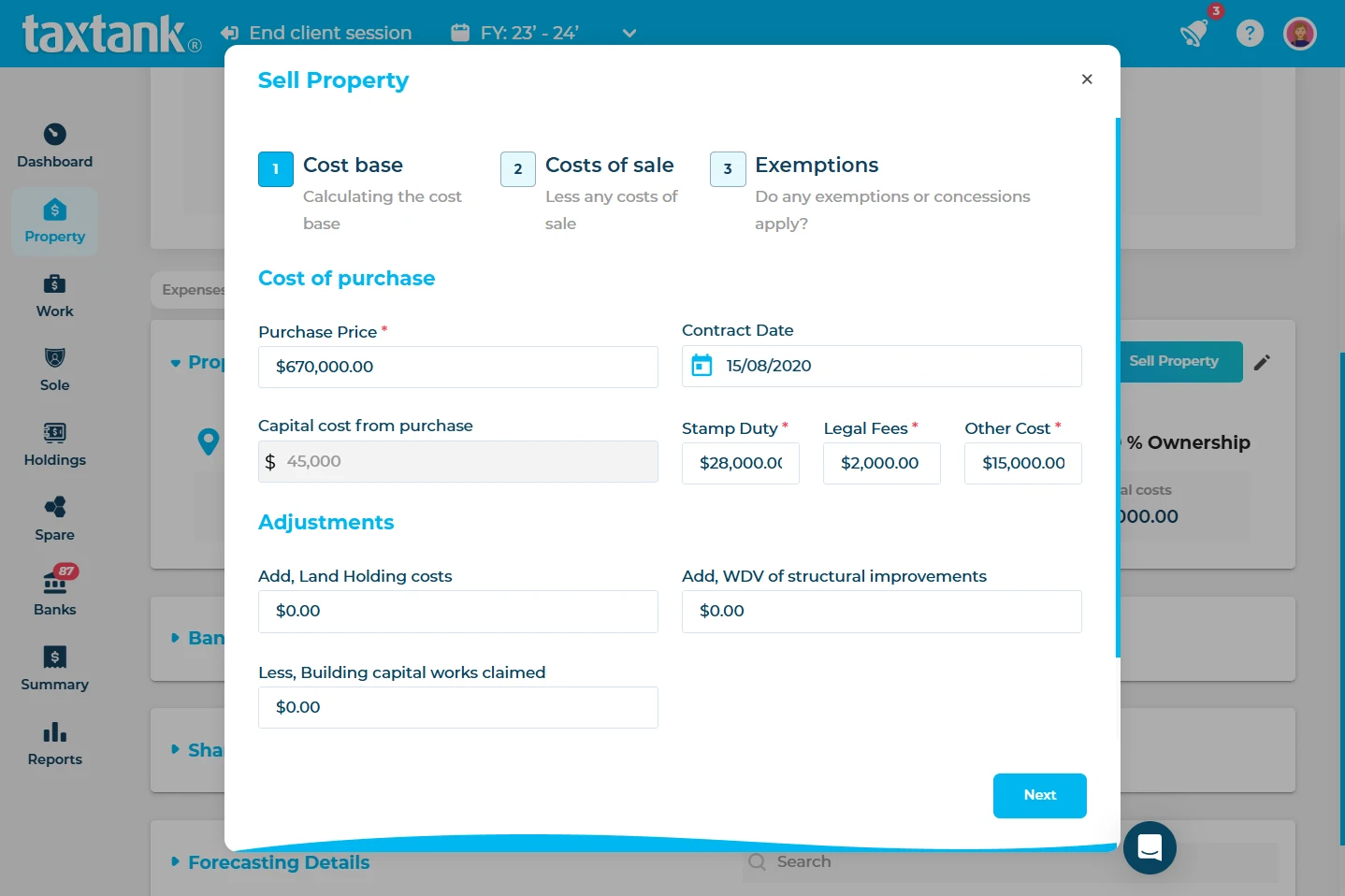
Including eligible costs in your property’s cost base can reduce the capital gain you make when selling. These may include purchase stamp duty, conveyancing fees, selling agent commissions and qualifying capital improvements.
Keep invoices and supporting records so you can identify every eligible cost. Expenses you have deducted, or can deduct, generally cannot also be included in the cost base. Capital works deductions may also require cost-base adjustments.
5. Time the Sale Strategically
Consider the timing of your asset sale to align with a financial year when your taxable income is lower. Since CGT is added to your assessable income, selling during a low-income year can place you in a lower tax bracket, reducing the overall tax payable.
6. Consider Eligible Deductible Super Contributions
Contributing a portion of your capital gain into your superannuation as a concessional (pre-tax) contribution can reduce your taxable income. These contributions are taxed at a concessional rate of 15% within the super fund, which is often lower than your marginal tax rate, resulting in significant tax savings.
7. Use Available Capital Losses
Under the current rules, eligible capital losses from property, shares, crypto or other assets can generally offset taxable capital gains, reducing the amount included in your taxable income. This includes eligible losses from the same financial year and unused losses carried forward from earlier years.
Capital losses are applied before any available CGT discount. They cannot offset salary or wages and generally cannot be carried back to reduce gains from previous years.
TaxTank helps you keep your property and investment records together, making it easier to review your gains and losses before selling. For gains accruing from 1 July 2027, check how the new CGT arrangements affect the treatment of your losses.
Practical Tools and Resources
Tax Calculators and Software
Online CGT calculators, like the ones on the Australian Taxation Office (ATO) website, can help estimate your liability. Alternatively, tax software such as TaxTank streamlines this process, ensuring you claim all eligible deductions.
Key Government Resources
The ATO is your go-to source for official guidelines on CGT. Check out their CGT essentials page for comprehensive information.
When to Seek Professional Advice
If your situation feels overwhelming, a tax advisor can provide tailored strategies to minimise CGT and help you navigate complex rules.
Top 3 Mistakes to Avoid with Capital Gains Tax (CGT)
Keeping Accurate Records
Poor record-keeping is one of the most common mistakes in managing CGT. To correctly calculate your cost base and maximise deductions, it’s essential to maintain detailed records of purchase prices, associated costs, improvements, and sale details. Using a platform like TaxTank simplifies this process, ensuring all your property-related data is securely tracked and accessible in one place.
Understanding the 12-Month Rule
The 50% CGT discount applies only if you’ve held the property for at least 12 months, calculated from the contract date of purchase to the contract date of sale, not the settlement dates. Misunderstanding this can disqualify you from significant tax savings. Planning your transactions carefully with this in mind can help you take full advantage of the discount.
Tracking Changes Between Home and Investment Property
If your property transitions between being your main residence and an investment property, it’s crucial to keep accurate records of market values and dates of use. This ensures you correctly apply the main residence exemption or calculate CGT. With TaxTank, you can seamlessly switch properties between home and investment portfolios, keeping your records organised and ensuring compliance with ease.
Frequently Asked Questions About CGT
What is the best way to reduce capital gains tax on an investment property?
The best way to reduce capital gains tax is to check your property’s cost base, available capital losses and eligibility for exemptions or discounts before you sell. TaxTank’s Property Tank helps you keep purchase costs, capital improvements, sale expenses and supporting documents together, making it easier to identify eligible costs and calculate your capital gain.
Sale timing and eligible deductible super contributions may also affect your overall tax bill. For gains accruing from 1 July 2027, the new CGT arrangements need to be considered alongside the transitional rules.
What expenses can reduce capital gains tax when selling property?
Eligible costs may include purchase stamp duty, conveyancing fees, selling agent commissions and qualifying capital improvements. These costs can increase your property’s cost base and reduce the capital gain. You generally cannot include expenses you have deducted or can deduct, and capital works deductions may require adjustments.
Can capital losses from shares or crypto reduce CGT on property?
Under the current rules, eligible capital losses from shares, crypto or other assets can generally offset taxable capital gains from property. Current-year and carried-forward capital losses are applied before any available CGT discount. Capital losses cannot be deducted from salary or wages, and unused losses are generally carried forward rather than carried back.
Is capital gains tax based on the contract date or settlement date?
For a standard property sale, the CGT event generally occurs when you enter into the sale contract, rather than when settlement takes place. A contract signed in June will usually fall in that financial year, even if settlement occurs in July. This matters when planning around 30 June or the CGT changes starting on 1 July 2027.
Can I spread a property capital gain over several tax years?
Generally, no. A capital gain from a standard property sale is normally reported in the financial year of the sale contract. Receiving the sale proceeds in instalments or settling in a later financial year does not usually spread the gain across multiple tax returns.
Can putting property sale proceeds into super reduce my tax?
An eligible personal super contribution that you claim as a deduction may reduce your taxable income in the year of the sale. However, simply putting sale proceeds into super does not automatically reduce tax. Contribution caps, eligibility requirements and notice-of-intent rules apply. Non-concessional contributions, including those made using the bring-forward rule, do not provide an income tax deduction.
Does paying off my mortgage reduce capital gains tax?
No. Repaying your mortgage reduces the cash you keep from the sale, but the outstanding loan balance does not reduce your capital gain. CGT is generally calculated using the sale proceeds and your adjusted cost base, rather than the amount left after repaying the bank.
Can I avoid capital gains tax by buying another property?
Generally, no. Using the proceeds from an investment property sale to buy another property does not automatically exempt the gain or defer CGT in Australia. An exemption or specific rollover must apply independently of how you spend the proceeds.
Does moving into an investment property before selling make it CGT-free?
No. Moving into a property that was previously rented out does not automatically erase the capital gain attributable to its earlier investment use. You may qualify for a partial main residence exemption, depending on the ownership and occupancy history. The six-year rule generally concerns a former home, rather than a property that has always been an investment.
Can TaxTank help me reduce capital gains tax?
TaxTank helps you keep property purchase costs, capital improvements, sale expenses and supporting documents together so eligible costs are easier to identify when calculating your gain. Property Tank also helps you understand your overall tax position. Your eligibility for exemptions and concessions depends on your circumstances and the applicable tax rules.
What happens if you don’t report CGT correctly?
The ATO uses advanced data-matching technology to identify discrepancies in property sales, share trading, and other asset disposals. If you fail to report CGT correctly, the ATO can impose hefty penalties and interest. Always double-check your calculations and maintain accurate documentation to ensure compliance.
Are non-residents eligible for CGT exemptions?
Non-residents typically don’t qualify for the main residence exemption and may face higher CGT rates. For example, non-residents are excluded from the 50% CGT discount on capital gains accrued after May 8, 2012.
Can you completely avoid paying CGT?
While it’s difficult to completely avoid CGT, exemptions like the main residence exemption and strategies like timing asset sales or utilising carried-forward losses can significantly reduce your liability. Proper planning and tools like TaxTank can help you navigate these strategies effectively.
Know your numbers before you sell
TaxTank helps you keep property purchase costs, improvements, sale expenses and supporting documents together, making it easier to calculate your capital gain and understand your overall tax position.
Explore Property Tank and start your 14-day free trial. No credit card required.