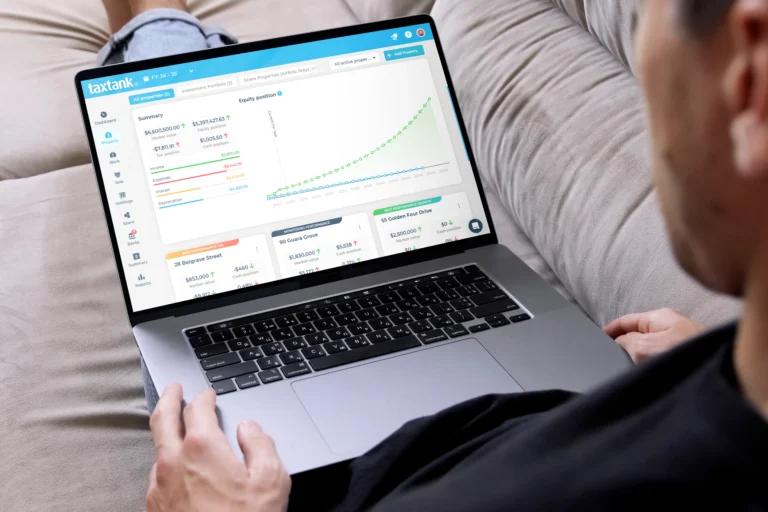


Looking for the best property app in Australia? This guide explains the different types of property apps available, how they compare and which is best for Australian property investors.
Choosing the best property app in Australia can make investing much easier. However, one of the biggest mistakes investors make is assuming all property apps do the same thing.
They don’t.
Some apps help you find your next investment property. Others help manage tenants and rental payments. Some focus on recording income and expenses, while others help you monitor your portfolio, prepare for tax or understand your overall financial position.
The best property app in Australia depends entirely on where you are in your investment journey and what you want the app to help you manage.
In this guide, we’ll explain the different types of property apps available in Australia, what each is designed to do and how to choose the right app for your needs.
Whether you’re looking for the best property app in Australia to research your next investment, manage your rental property or stay on top of your finances and tax, understanding what each type of property app is designed to do will help you choose the right solution.
What Is the Best Property App in Australia?
When people search for the “best property app”, they’re often comparing completely different types of apps or software.
Some are designed for property managers.
Some are designed for landlords.
Others are designed specifically for property investors.
Many Australian property investors end up using more than one property app. For example, you might use one app to find a property, another to manage tenants and a property app like TaxTank to manage your finances, portfolio and tax throughout the year.
| Type of property app | Best for |
|---|---|
| Property search apps | Finding investment opportunities |
| Property research apps | Analysing potential investments |
| Property management apps | Managing tenants and leases |
| Property accounting apps | Tracking rental income and expenses |
| Property portfolio apps | Monitoring cash flow, debt and equity |
| Property tax apps | Managing deductions, depreciation and capital gains |
The important thing to understand is that many investors use more than one type of app.
For example, you might use a property search app to find your next investment, a property manager to handle tenants and TaxTank to manage the financial side of your portfolio.
Stage 1: Finding Your Next Investment Property
Every investment starts with finding the right property.
Property search apps are one of the most popular types of property apps in Australia, helping investors find thousands of listings.
Typical features include:
- Property listings
- Saved searches
- Auction results
- Inspection times
- Property photos
- Estimated repayments
- Agent details
- Previous sale history
Property search apps are excellent for discovering opportunities, viewing listings and comparing properties currently on the market.
However, they are mainly designed to help you find a property. Once you have identified one that interests you, the next question is whether it suits your investment strategy and financial position.
That is where more detailed property research and modelling become important.
Stage 2: Researching Before You Buy
Before committing to an investment property, most investors want to answer questions like:
- What is the property really worth?
- How much equity could it generate?
- Will the rental income cover the expenses?
- How will it affect my cash flow?
- What impact will it have on my tax?
Property research apps and market data platforms can help investors compare prices, suburb performance, rental demand and estimated property values.
Most investors will use listing and research apps to find and investigate potential opportunities. Once they have identified a particular property, they may also want to understand how the purchase could affect their own cash flow, portfolio and tax position.
TaxTank can be used at this stage of the process.
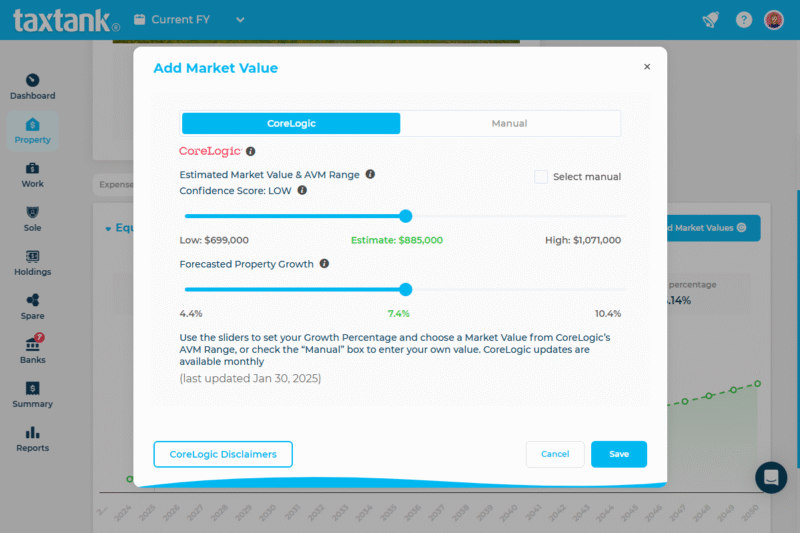
Instead of waiting until you have purchased the property, you can add a property you are considering directly into your portfolio. Using CoreLogic property data, you can review its estimated market value and assess how the property may fit within your broader financial position.
If you decide not to proceed with the purchase, you can simply deactivate the property.
This allows investors to compare opportunities without cluttering their portfolio with properties they never bought.
Why this matters
Most property apps help you after you’ve purchased the property.
TaxTank can also help you evaluate opportunities before you commit.
Stage 3: Managing Your Investment Property
Once you’ve purchased a property, your focus shifts from buying to managing it.
This is where many people immediately think about property management software.
For many landlords, a property management app is the next property app they’ll use after purchasing an investment property.
Typical features include:
- Tenant applications
- Lease agreements
- Rent collection
- Maintenance requests
- Property inspections
- Bond management
- Owner statements
- Communication
If you’re a self-managing landlord, these tools can save significant time.
However, if you already have a professional property manager, many of these features are already provided for you.
What they don’t generally manage is your own financial position as the property owner.
For example, your property manager won’t normally track:
- Expenses you pay personally
- Loan interest
- Borrowing costs
- Property equity
- Capital improvements
- Depreciation
- Capital gains records
- Your overall tax position
That’s where investor-focused software becomes important.
If you manage your own tenants, you may still choose to use a dedicated property management app alongside TaxTank.
The two types of property app perform different roles. Property management apps focus on tenants, leases, rent collection and maintenance, while TaxTank focuses on the investor’s property finances, portfolio and tax position.
Stage 4: Managing Your Property Finances
A property accounting app helps investors organise the financial side of property ownership. Once your property is generating rental income, keeping accurate financial records becomes essential.
Many investors begin with spreadsheets.
Others use general accounting software designed for businesses.
While these options can work, they often require significant manual effort because they aren’t built specifically for property investors.
Purpose-built property accounting apps make this much easier.
Typical features include:
- Rental income tracking
- Property expense categories
- Receipt storage
- Bank transaction imports
- Cash flow reporting
- Accountant reports
If your main goal is simply to record rental income and expenses, a property accounting app or general income and expense tracker may be enough.
However, these apps generally focus on recording transactions and producing reports. They may not calculate how those transactions affect your broader Australian tax position.
TaxTank includes property accounting features such as live bank feeds, rental income and expense tracking, receipt storage, cash flow reporting and accountant reports. It then connects that information with your property tax records and overall financial position.
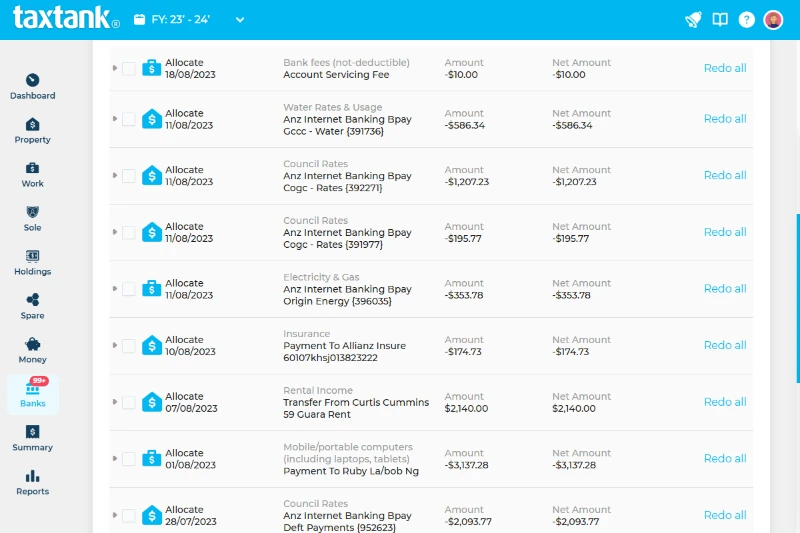
This means investors can do more than organise transactions. They can also understand how their property income, expenses and deductions may affect their estimated tax throughout the year.
If you’re looking for a more detailed comparison, we’ve also created a dedicated guide to the Best Property Accounting Software in Australia.
Stage 5: Monitoring Your Property Portfolio
A property portfolio app helps investors monitor how one or more properties are performing.
These apps may track:
- Property values
- Loan balances
- Equity
- Rental yields
- Cash flow
- Capital growth
- Portfolio performance
Some property portfolio apps act primarily as trackers, while others also connect property finances with Australian tax calculations and the investor’s broader financial position.
TaxTank combines property portfolio tracking with live bank transactions, property accounting, CoreLogic property data and supported tax calculations.
For a detailed explanation of what these platforms should include, read our guide to choosing the best property portfolio app in Australia.
Stage 6: Managing Property Tax
A property tax app focuses on the tax side of owning investment property.
Throughout the year you’ll also need to manage:
- Rental income
- Property deductions
- Loan interest
- Borrowing costs
- Council rates
- Insurance
- Repairs and maintenance
- Depreciation
- Capital improvements
- Ownership percentages
- Capital gains records
Many investors only think about these items when it’s time to lodge their tax return.
Unfortunately, that’s also when they discover missing receipts, forgotten expenses or incomplete records.
Keeping everything organised throughout the year makes tax time significantly easier. The ATO requires rental property records to be kept for the relevant retention period, with some records required for as long as you own the property and for five years after the related CGT event.
Property tax software is designed specifically for this purpose.
Rather than simply recording transactions, it helps investors maintain the records needed to calculate their rental property tax position.
TaxTank goes one step further.
Instead of only preparing information for your accountant, it continually updates your estimated Australian tax position as your property income, expenses and other investments change throughout the year.
If you’d like a detailed comparison of this category, we’ve created a separate guide to the Best Property Tax Software in Australia.
Why TaxTank Is Different
Most property apps specialise in a particular part of property investing.
Property search apps help investors find opportunities. Property management apps focus on tenants and leases. Accounting apps organise rental transactions, while portfolio apps monitor values, debt and equity.
These tools can all be useful, depending on what the investor needs.
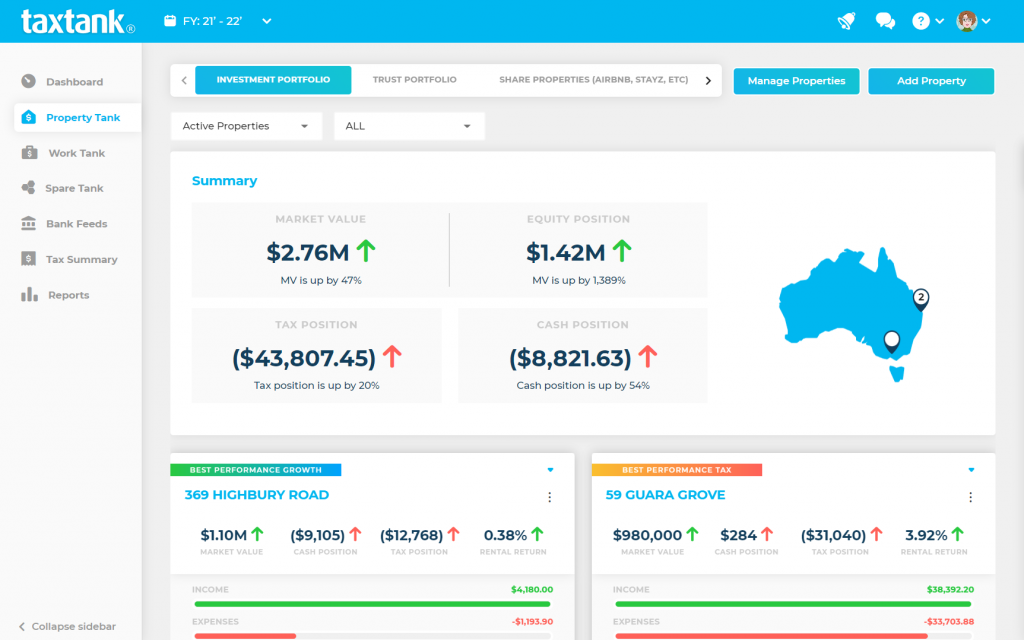
TaxTank’s Property Tank is different because it combines many of the financial functions investors would otherwise manage across several property apps. It supports property research and modelling, property accounting, portfolio tracking, Australian property tax and broader personal financial management in one place.
The main area TaxTank does not replace is tenant and lease management.
With TaxTank you can:
Research properties before you buy
Add a property you’re considering to understand how it may fit into your portfolio.
Review CoreLogic property values, estimate the financial impact and remove the property later if you decide not to purchase it.
Track rental income and expenses
Automatically import transactions through eligible live bank feeds or add them manually.
Allocate income and expenses using Australian property tax categories.
Monitor your portfolio
Track:
- Property values
- Loan balances
- Equity
- Cash flow
- Rental performance
- Multiple properties
All from one dashboard.
Stay tax ready
Manage:
- Property deductions
- Depreciation
- Borrowing costs
- Capital improvements
- Capital gains records
Throughout the financial year rather than trying to reconstruct everything at tax time.
Understand your overall financial position
Property is only one part of your finances.
TaxTank can also manage:
- PAYG employment income and work-related deductions
- Sole trader income and expenses
- Shares and cryptocurrency
- Australian and foreign investment properties
- Supported New Zealand and multicurrency bank accounts, including Wise
- Personal spending, budgets, bills and financial goals through Money Tank
This means your property is not managed in isolation.
You can see how it contributes to your overall financial position and estimated tax outcome while managing the personal finance side through the same platform.
Tracking Property Information vs Understanding the Result
Many property apps record one part of property investing, such as values, loans, rental income, expenses or cash flow.
TaxTank connects supported property information with Australian tax calculations and the investor’s broader financial position. This helps investors understand what their property activity may mean alongside employment income, business activity and other investments, rather than reviewing the portfolio in isolation.
| Stage of property investing | Typical app used | How TaxTank fits |
|---|---|---|
| Finding properties | Property search app | Properties are generally found through listing platforms |
| Researching a purchase | Research and market data app | Add a potential property, review CoreLogic data and assess its portfolio impact |
| Managing tenants | Property management app | TaxTank does not manage tenants or leases |
| Tracking income and expenses | Property accounting app | Live bank feeds, property categories, receipts and reports |
| Monitoring values, debt and equity | Property portfolio app | CoreLogic values, loans, equity, cash flow and portfolio tracking |
| Managing property tax | Property tax app | Deductions, depreciation, borrowing costs and CGT |
| Understanding your overall position | Often multiple apps or spreadsheets | Property, employment, business, investments and personal finances through one platform |
Do You Still Need a Property App If You Have a Property Manager?
A property manager and a property investor have different responsibilities.
Your property manager generally looks after:
- Tenants
- Leases
- Rent collection
- Maintenance
- Inspections
- Owner statements
As the investor, you’re still responsible for:
- Loan interest
- Expenses paid personally
- Depreciation
- Capital improvements
- Property values
- Equity
- Tax planning
- Capital gains records
- Your overall financial position
Property management software and investor software are designed for different users.
Many TaxTank customers use a professional property manager while relying on TaxTank to manage everything outside the tenancy itself.
Why More Property Investors Are Moving Beyond Spreadsheets
Spreadsheets have been the traditional way to manage investment properties for years.
While they can work, they also require ongoing manual updates.
As portfolios grow, they become increasingly difficult to maintain.
A purpose-built property investment tracker can automatically:
- Import bank transactions
- Track rental income
- Categorise expenses
- Store receipts
- Monitor property values
- Calculate portfolio equity
- Generate accountant reports
- Keep records organised throughout the year
Instead of spending hours updating spreadsheets, investors can spend more time making informed investment decisions.
Final Thoughts
There is no single property app that is best for every task.
Property search and research apps help investors find and assess opportunities. Property management apps are useful for tenants, leases and rent collection. Accounting and portfolio apps help organise transactions and monitor investment performance.
The best property app in Australia depends on what you need it to do.
TaxTank is designed for investors who want more than a basic tracker. It combines property research and modelling, property accounting, portfolio tracking and Australian tax calculations so investors can understand how their properties fit within their broader financial position.
It can be used before purchasing a property, throughout the period of ownership and when preparing for an eventual sale.
Investors who manage tenants themselves may still need a dedicated property management app. For the financial and tax side of property investing, TaxTank brings many of the functions normally spread across several apps into one place.
Frequently Asked Questions
What is the best property app in Australia?
The best property app depends on what you’re trying to achieve. Property search apps help you find investment opportunities, while TaxTank helps investors manage their property finances, portfolio and tax throughout the year.
Are all property apps basically the same?
No. Many property apps specialise in one area of property investing. For example, some focus on finding properties, others manage tenants, while many simply track rental income, expenses or portfolio performance.
TaxTank is different because it combines many of these functions into a single property app for Australian investors. Instead of only tracking information, it helps you understand how your properties affect your cash flow, equity and overall tax position.
What is the difference between a property app and a property management app?
A property app is a broad term covering software for researching properties, tracking investments, managing finances and preparing for tax. A property management app focuses specifically on tenants, leases, rent collection and maintenance. TaxTank is designed for property investors who want to manage the financial side of property ownership.
Can I manage multiple investment properties in TaxTank?
Yes. TaxTank allows you to manage multiple investment properties while tracking rental income, expenses, loan balances, equity and portfolio performance in one place. You can also manage properties if they are held in a trust, SMSF or company.
Does TaxTank track property values?
Yes. TaxTank integrates with CoreLogic property data so investors can monitor estimated property values alongside debt, equity and portfolio performance.
Can I research a property before buying it with TaxTank?
Yes. You can add a property you’re considering to TaxTank, review its estimated value and model how it fits within your investment portfolio. If you decide not to proceed with the purchase, simply deactivate the property.
Why TaxTank Is One of the Best Property Apps in Australia
TaxTank combines many of the features Australian property investors would normally need across several different property apps.
You can research a potential purchase, connect live bank transactions, manage rental income and expenses, monitor property values, debt and equity, comply with ATO record-keeping requirements and calculate how your properties affect your estimated tax position throughout the year.
Property Tank can also connect with employment income, sole trader activities, shares, cryptocurrency and personal finances through the broader TaxTank platform.
Whether you are considering your next purchase, managing an existing portfolio or preparing for an eventual sale, TaxTank gives you one place to manage the financial and tax side of property investing.
You don’t need to know property tax. You just need TaxTank. It knows the rules, so you don’t have to.
No credit card required