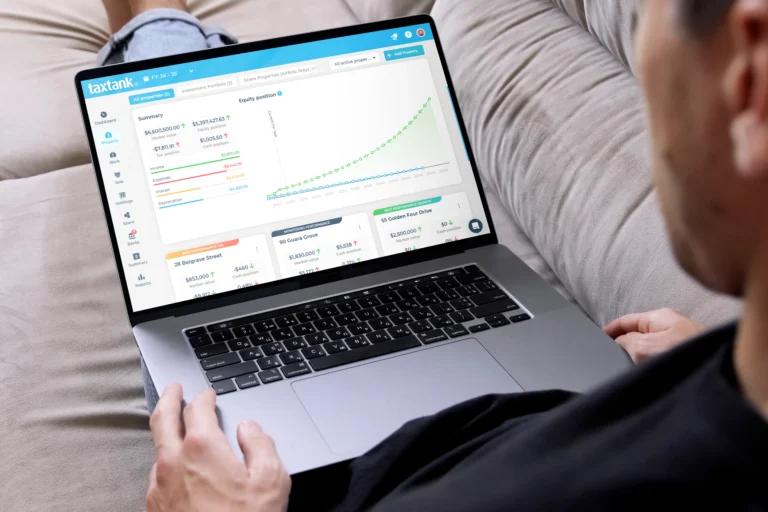


Property portfolio apps in Australia range from simple property trackers to wealth management platforms and tax-focused software. The best option depends on whether you want to monitor property values and cash flow, manage rental income and expenses, keep tax records, or calculate how your property portfolio affects your individual tax position.
TaxTank combines property portfolio tracking with Australian individual tax calculations, bringing property income, expenses, loans, depreciation, negative gearing and capital gains together with your other income and investments.
Managing a property portfolio involves much more than watching property values rise and rental income arrive.
You need to track loans, equity, income, expenses, depreciation, ownership, documents, cash flow, capital gains and the tax treatment that applies to each property.
With major changes to negative gearing and capital gains tax beginning on 1 July 2027, choosing an app that only produces an attractive portfolio dashboard may leave you managing the most complicated part somewhere else.
The best property portfolio app should not just show you what your properties are worth. It should help you understand how they are performing, what records you need and what the portfolio means for your complete financial and tax position.
TaxTank brings property tracking, finances, performance and Australian tax calculations into one platform built for individual investors.
No credit card required
What is a property portfolio app?
A property portfolio app helps investors organise and monitor the properties they own.
Depending on the platform, it may track:
- Property values
- Loan balances
- Available equity
- Rental income
- Property expenses
- Cash flow
- Rental yield
- Capital growth
- Ownership information
- Documents and receipts
- Tax deductions
- Depreciation
- Capital gains
However, not every property portfolio app performs the same role.
Some are basic portfolio trackers. Some focus on forecasting or property research. Others record income and expenses so information can be exported at tax time.
These features can be useful, but recording property information is not the same as calculating how each property affects your tax.
That distinction matters because your property portfolio does not exist separately from the rest of your financial life.
Property tracking is only the beginning
A portfolio dashboard may show that:
- Your property is worth $750,000
- Your loan balance is $480,000
- You have $270,000 in equity
- Your rent increased by $40 per week
- Your annual expenses were $18,000
- Your property produced a cash flow loss
That gives you useful information about the property.
It does not necessarily tell you:
- Which expenses are deductible
- Whether an expense must be claimed over several years
- How ownership affects the result
- Whether depreciation or capital works deductions apply
- Whether a rental loss can reduce your salary income
- How much of a future capital gain will be taxable
- How the property affects your Medicare levy, HELP repayment or other individual tax obligations
- What happens when different properties in the same portfolio are subject to different tax rules
A property portfolio app should help you understand the numbers, not simply collect them.
Property portfolio apps in Australia compared
Not all property portfolio apps do the same job. Some focus on property values and equity, while others concentrate on cash flow, wealth management or tax record keeping. TaxTank takes a broader approach, connecting property portfolio management with financial-year tax calculations, multiple ownership structures, foreign properties and income, Open Banking, and an individual’s other income and investments.
| Type of app | Examples | Property values & equity | Income & expenses | Financial year tracking | Individual tax calculations | Multiple ownership structures | Foreign properties & income | Open Banking | Other income & investments |
|---|---|---|---|---|---|---|---|---|---|
| Property portfolio trackers | Property Dollar, Opulo, Propboss | Varies | ✓ | Varies | No | Limited | Varies | Varies | No |
| Wealth management tools | Moorr, Gather | ✓ | ✓ | Varies | No | Limited | Varies | Varies | ✓ |
| Property tax record tools | Vestly, The Property Accountant | Varies | ✓ | Varies | Limited | Varies | Varies | Varies | No |
| Integrated property, finance & tax management platform | TaxTank | ✓ CoreLogic integration | ✓ | ✓ FY2020/21 onwards | ✓ | ✓ | ✓ | ✓ | ✓ |
Tracking property tax is not the same as calculating your tax
Many property apps can record rental income and expenses, identify potentially tax-deductible costs or calculate a property’s profit or loss. That does not necessarily mean they calculate your individual tax.
A property’s tax result needs to be considered alongside your other income, deductions and investments to understand how it affects your overall tax position for the financial year.
TaxTank does this differently. Property Tank connects your property income, expenses, loan interest, depreciation, negative gearing and capital gains with your employment income, sole trader activities, shares, cryptocurrency and other investments. These feed into one estimated individual tax position throughout the financial year.
What type of property portfolio app do you need?
The right property portfolio app depends on what you want to manage. A portfolio tracker may be enough if you primarily want to monitor property values, equity and cash flow. A wealth management tool can be useful if you want a broader view of your assets and net worth, while a property tax record tool can help organise information for tax time.
If you want to understand how your properties affect your individual tax throughout the financial year, look for software that goes beyond record keeping. This means bringing property income, deductible expenses, loan interest, depreciation, capital gains and losses together with your other taxable income and investments.
What should the best property portfolio app track?
The right app should give you an accurate view of each property while also showing how the portfolio works together.
Property values and equity
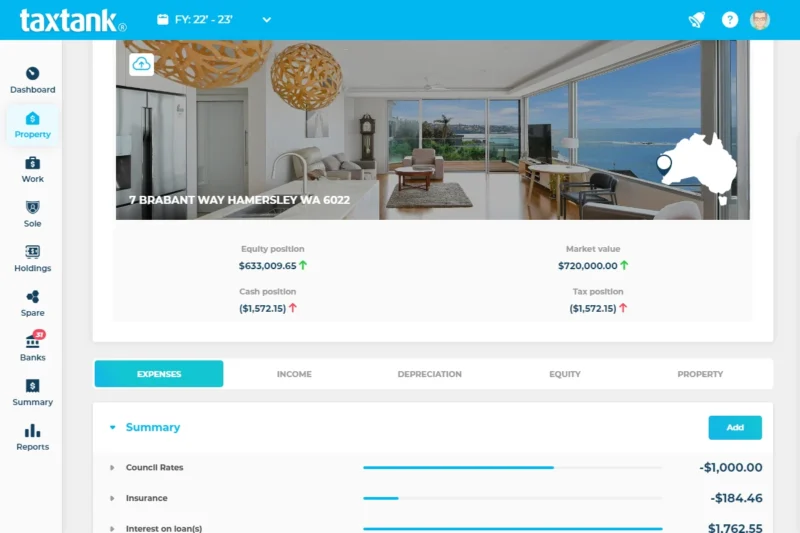
Tracking estimated property values alongside current loan balances helps you monitor equity across individual properties and the wider portfolio.
For Australian properties, TaxTank integrates with CoreLogic to help keep property information and estimated values current.
With Property Tank, you can review property values, debt and equity without maintaining a separate spreadsheet.

Rental income and expenses
A property portfolio app should allow you to record rental income and allocate expenses to the correct property.
TaxTank connects to eligible Australian and foreign bank accounts through Open Banking.
Transactions can then be allocated using property categories based on Australian tax requirements.
This helps keep income and expenses organised throughout the year instead of trying to reconstruct everything from bank statements at tax time.
Loans and borrowing costs
Your loan affects cash flow, equity and tax, but the loan repayment itself is not necessarily the deductible amount.
A useful property app should distinguish between:
- Interest
- Principal repayments
- Borrowing costs
- Bank fees
- Refinancing costs
- Loan balances
- Offset accounts
TaxTank keeps loan information connected to the relevant property and applies the supported tax treatment to the information recorded in your account.
Property performance
Rental yield alone does not provide a complete picture of an investment.
Property performance can also depend on:
- Rental income
- Vacancy
- Operating expenses
- Loan interest
- Capital growth
- Depreciation
- Tax deductions
- Ownership percentage
- Cash invested
- After-tax cash flow
TaxTank allows you to review property performance alongside the financial and tax information behind it.
Depreciation and capital works
Depreciation and capital works deductions can significantly affect the taxable result of an investment property.
However, they may also affect the property’s cost base when it is eventually sold.
Property Tank helps you manage supported depreciating assets and capital works while keeping the relevant history connected to the property.
This means a deduction claimed today does not become a missing piece of information years later when the property is sold.
Documents and records
Property investors need to retain records supporting rental income, expenses, ownership, loans, depreciation and capital gains.
A portfolio app should allow you to store relevant documents with the property or transaction they support.
TaxTank keeps receipts, statements, depreciation schedules, settlement documents and other records connected to your property information.
This helps you comply with ATO record-keeping requirements for rental properties.
The best property portfolio app should understand ownership
A property is not always owned by one person in their individual name.
Your portfolio may include properties that are:
- Individually owned
- Jointly owned
- Held in a trust
- Held in a company
- Held by an SMSF
- Managed through another supported ownership structure
- Located outside Australia
The ownership structure determines where income, expenses, deductions and capital gains belong.
TaxTank lets you organise properties across supported ownership structures without mixing every result into your personal tax calculation.
Properties that contribute to your individual tax position are included where applicable. Properties belonging to separate entities remain organised separately because those entities have their own tax and reporting obligations.
This allows you to see the complete property portfolio while maintaining the correct separation between owners and entities.
You can manage everything through one account without paying for a separate platform subscription for every ownership structure.
Australian and foreign properties in one portfolio
Australian investors may also own property overseas.
Foreign properties can create additional work because rental income, expenses and transactions may need to be converted into Australian dollars before they can be included in the owner’s Australian tax position.
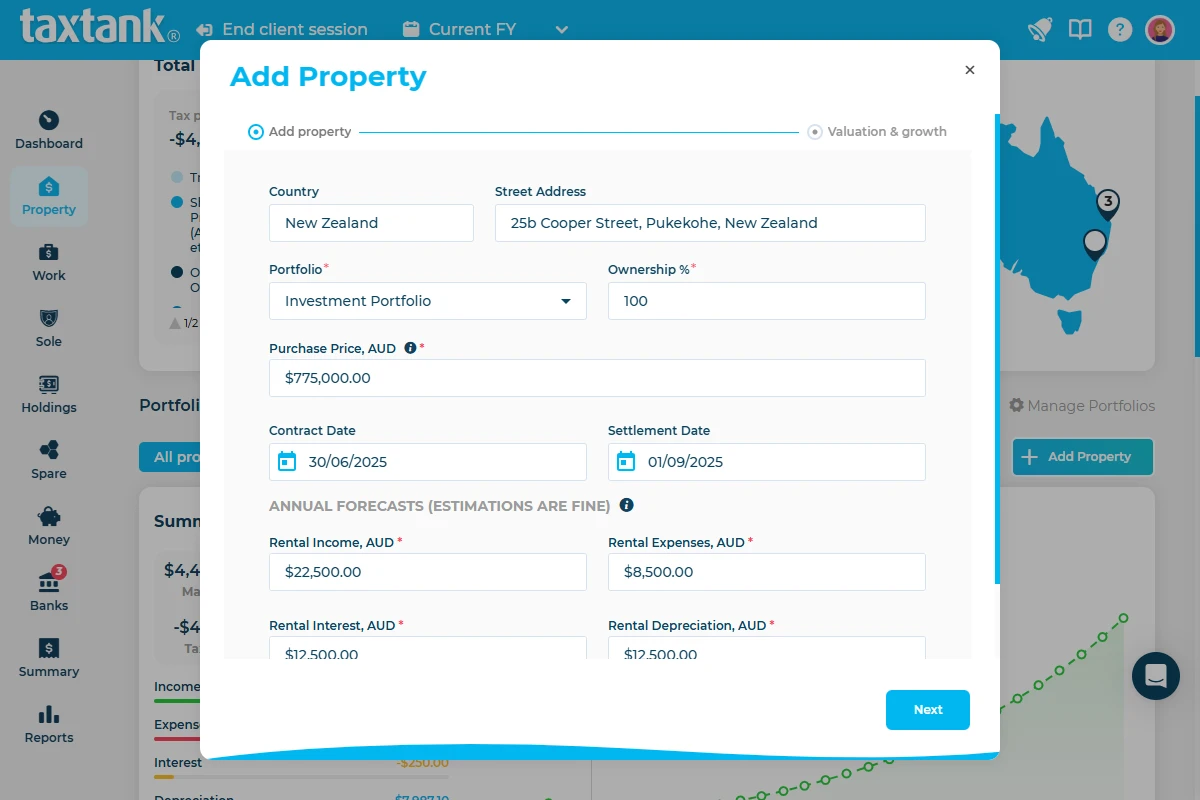
Property Tank allows you to manage supported Australian and foreign investment properties in the same portfolio.
You can record foreign property income, expenses, ownership information and supporting documents while keeping the relevant Australian tax treatment connected to your account.
You can add foreign bank accounts in their original currency using live bank feeds where available, or enter transactions manually when a live connection is not supported. TaxTank automatically converts the relevant foreign income and expenses into Australian dollars for your property records and tax calculations.
Your property portfolio is not your complete financial position
A property app might calculate that one rental made a $12,000 loss during the financial year.
But the effect of that loss can depend on:
- Your salary
- PAYG tax already withheld
- Income from other properties
- Sole trader income
- Dividends and investment income
- Capital gains
- Carried-forward losses
- Ownership percentage
- The tax rules that apply to the property
- Other individual tax obligations
This is why showing a property loss is not the same as calculating the tax result.
TaxTank connects supported property information with the other areas of your financial life.
Depending on the Tanks you use, your estimated individual tax position can include:
- Employment income and PAYG withholding
- Work-related deductions
- Sole trader activities
- Australian and foreign properties
- Shares and cryptocurrency
- Capital gains and losses
- Investment income
- Other supported individual tax information
Each area remains organised separately while contributing to the same estimated individual tax position where applicable.
Instead of asking your property app what happened and then using another calculator to estimate the tax, TaxTank calculates the supported result as your information changes.
Property tax is changing from 1 July 2027
The tax rules applying to Australian property investors are becoming more complicated.
From 1 July 2027, negative gearing for residential property will generally be limited to new builds, with grandfathering provisions for properties held before 7:30 pm AEST on 12 May 2026.
Investors who acquire established residential property after that time may still apply eligible losses against other residential property income, including relevant capital gains, and carry unused losses forward.
However, those losses will not generally be available to reduce non-residential income such as salary.
Capital gains tax is also changing from 1 July 2027.
The existing 50% CGT discount will be replaced for gains accruing from that date with indexation for inflation and a minimum 30% tax rate on real capital gains. Gains that accrued before 1 July 2027 retain their existing treatment.
These reforms mean one property portfolio may eventually contain:
- Grandfathered properties
- New builds eligible for negative gearing
- Established properties with quarantined losses
- Losses available against residential property income
- Losses carried forward from previous years
- Capital gains accrued before 1 July 2027
- Capital gains accrued after 1 July 2027
- Properties sold under calculations spanning both CGT systems
The relevant treatment will depend on acquisition dates, property history, available losses and the investor’s broader tax position.
TaxTank will automatically incorporate the new negative gearing and CGT rules into its calculations when they take effect.
The acquisition date, ownership, property type, income, expenses, carried-forward losses, depreciation and cost-base history recorded in TaxTank will allow the applicable treatment to be applied to each property.
That includes maintaining the existing treatment for eligible grandfathered properties, quarantining losses where required and applying the relevant CGT calculation to gains accruing before and after 1 July 2027.
You will not need to maintain separate spreadsheets, manually identify which rules apply to each property or rebuild your calculations when a property is eventually sold.
TaxTank will maintain the different layers of property tax rules in the software and automatically include the applicable results in your estimated individual tax position.
The Australian Treasury’s property tax reforms make connected, year-round property records more important than ever.
Why spreadsheets and simple trackers will struggle with the new rules
A spreadsheet can record when you bought a property.
It can also record income, expenses and a running profit or loss.
The difficulty begins when different properties need to follow different tax treatments over multiple financial years.
You may need to know:
- Whether the property is grandfathered
- Whether it qualifies as a new build
- Whether a rental loss can reduce salary income
- Whether a loss must remain within the residential property system
- Which carried-forward losses are still available
- How those losses interact with later rental profits or capital gains
- How much of a capital gain accrued before and after 1 July 2027
- Whether depreciation and capital works have affected the cost base
- How the final property result interacts with the rest of your income
A spreadsheet does not maintain tax legislation.
It only contains the formulas someone has entered. When the rules change, the spreadsheet must be rebuilt, tested and applied correctly to every affected property.
A basic portfolio app or tracker may avoid the spreadsheet formulas, but it can still leave the actual tax calculation to you or your accountant.
Why financial year tracking matters for property investors
Property investing is long term, but Australian tax is calculated by financial year. That makes the ability to separate and maintain property records across financial years particularly important.
TaxTank is built around Australian financial years rather than simply providing a continuous record of property transactions. Property Tank supports records from the 2020/21 financial year onwards, allowing investors to maintain the history of their property income, expenses and tax-related information across multiple financial years.
This becomes particularly important when a property is held for many years. Depreciation, capital works, borrowing costs, carried-forward information and the eventual capital gain or loss can depend on records accumulated across different financial years.
It also means investors can move between financial years without losing sight of how their property portfolio has contributed to their broader tax position over time.
TaxTank maintains the property history and applies the supported Australian tax treatment as the relevant rules take effect.
Tracking tax categories is not the same as calculating tax
More property portfolio apps are beginning to allocate expenses into categories that resemble the ATO rental property schedule.
That can make accountant handover easier.
It does not mean the app calculates your individual tax.
There is an important difference between:
- Categorising a transaction as property repairs
- Determining whether the amount is immediately deductible
- Working out each owner’s share
- Calculating the property’s taxable result
- Applying the correct negative gearing treatment
- Including the result in the owner’s taxable income
- Calculating the resulting individual tax position
TaxTank does not stop at categorising the transaction.
It connects the information to an Australian individual tax engine so you can understand what it means for your tax throughout the financial year.
Most property portfolio apps record what happened. TaxTank tells you what it means for tax.
A property dashboard versus a complete property and tax platform
| Typical property portfolio app | TaxTank |
| Tracks property values | Tracks values using supported property data and connects them to portfolio performance |
| Shows loan balances and equity | Connects loans, interest, borrowing costs, equity and property performance |
| Records rental income and expenses | Allocates transactions using Australian property tax categories |
| Shows cash flow | Shows property performance and the supported taxable result |
| Produces tax-ready reports | Calculates how eligible property activity affects individual tax |
| Records deductions | Applies supported Australian tax treatment |
| May not organise records by financial year | Maintains relevant property and tax history across financial years |
| Shows each property separately | Shows individual properties and the complete portfolio |
| Treats property as a separate financial area | Connects property with employment, business and investment income |
| Supports simple personal ownership | Organises properties across supported ownership structures |
| Focuses on Australian properties | Supports Australian and foreign investment properties |
| Requires tax rules to be handled elsewhere | Updates supported calculations as Australian tax rules change |
A property dashboard can be useful.
A property dashboard connected to a maintained Australian tax engine is more useful.
Learn more about how property portfolio software can bring property management, performance and tax information together.
Manage the complete property lifecycle
TaxTank can help organise supported information from the time you begin considering a property until it is eventually sold.
Before purchasing
Add a potential property and review supported CoreLogic information before deciding whether to proceed.
If you do not purchase it, you can remove it without adding it to your active portfolio.
When you purchase
Record:
- Acquisition date
- Purchase price
- Ownership
- Loan information
- Settlement costs
- Initial repairs and improvements
- Supporting documents
This establishes the history that may later be required for depreciation, deductions and CGT.
While you own it
Track:
- Rental income
- Property expenses
- Loans and interest
- Depreciation
- Capital works
- Property values
- Equity
- Cash flow
- Performance
- Tax outcomes
- Supporting records
When you renovate or refinance
Keep improvement costs, borrowing information and supporting documents connected to the correct property.
This helps distinguish regular operating expenses from amounts that may affect depreciation, capital works or the cost base.
When you sell
Use the acquisition, ownership, improvement, depreciation and disposal information already maintained in your account to calculate the supported capital gain or loss.
You do not need to rebuild years of property records after the sale has occurred.
Do you still need a portfolio app if you have a property manager?
Yes.
A property manager and a property portfolio app perform different roles.
Your property manager may handle:
- Tenants
- Leases
- Rent collection
- Inspections
- Maintenance requests
- Property communications
- Monthly statements
A property portfolio app helps you manage the financial position of the owner.
This may include:
- Loans
- Equity
- Property values
- Ownership
- Tax deductions
- Depreciation
- Capital works
- Cost-base information
- Portfolio performance
- Your live tax position
Your property manager manages the tenancy.
TaxTank helps you manage what the property means for you.
Property Tank pricing
$15 per month, paid annually.
Property Tank includes up to five properties.
Additional properties can be added for $36 each per year.
Property Tank includes:
- Australian and foreign investment properties
- Supported ownership structures
- Eligible Australian and foreign bank accounts
- Secure Open Banking feeds
- CoreLogic integration for supported Australian properties
- Rental income and expense tracking
- Australian property tax categories
- Loans and borrowing costs
- Property values and equity
- Property performance
- Depreciating assets
- Capital works
- Negative gearing calculations
- Capital gains tax calculations
- Document and receipt storage
- Property and tax reports
- Live individual tax calculations for applicable properties
You can add Work Tank, Sole Tank, Holdings Tank or Money Tank when you want to connect other parts of your financial life.
Bundle discounts apply when you subscribe to more than one Tank.
No credit card required
Frequently asked questions
What is the best property portfolio app in Australia?
TaxTank is the best property portfolio app in Australia if you want to track your investment properties and understand their tax impact throughout the year. Its Property Tank brings rental income, expenses, loans, property values, equity and tax calculations together in one place.
With live bank feeds through Open Banking, TaxTank helps you track rental income and property expenses as transactions happen. You can store receipts and documents, monitor loans and keep each property’s financial records organised without relying on spreadsheets.
Australian tax rules are built into the platform, so property income, eligible deductions, depreciation, negative gearing and capital gains feed into your calculated personal tax position. You can see how your investment properties affect your tax alongside your salary and other income.
For Australian property investors who want portfolio tracking and year-round tax visibility, TaxTank gives you both in one app.
What should a property portfolio app include?
A property portfolio app should include property values, loan balances, equity, rental income, expenses, cash flow, ownership information, performance reporting and document storage.
For Australian investors, it should also manage depreciation, capital works, tax deductions, negative gearing, CGT and the records required to support those calculations.
Does TaxTank calculate investment property tax?
Yes. TaxTank applies supported Australian property tax treatment to the information entered or allocated to your account.
It calculates the taxable result for applicable properties and includes your ownership share in your broader individual live tax position.
Does TaxTank support the property tax changes from 1 July 2027?
Yes. TaxTank will incorporate the new negative gearing and CGT rules into supported calculations when they take effect.
TaxTank keeps acquisition dates, ownership, transaction history, losses and cost-base information connected to each property so the applicable treatment, including relevant grandfathering provisions, can be applied.
Can TaxTank manage more than one property?
Yes. You can add as many properties as you like to TaxTank.
You can review each property separately and monitor the complete portfolio through the same account.
Can TaxTank manage properties with different ownership structures?
Yes. TaxTank supports properties associated with individual, joint and other supported ownership structures like companies, trusts and SMSFs.
Properties belonging to separate entities remain separated from your personal tax calculation where required.
Can TaxTank track foreign investment properties?
Yes. TaxTank supports foreign investment properties for Australian residents, allowing overseas rental activity to be managed alongside Australian properties.
Foreign property income and expenses are converted to Australian dollars and the supported Australian tax treatment is applied when calculating your estimated individual tax position. This means an overseas property does not need to sit outside the rest of your property portfolio or tax calculations.
Can I connect foreign bank accounts?
TaxTank supports eligible foreign bank accounts from its Open Banking provider, Basiq.
Relevant foreign currency amounts are automatically converted to Australian dollars for supported Australian tax calculations.
Does TaxTank include Open Banking?
Yes. TaxTank connects to eligible Australian financial institutions through secure Open Banking.
Once connected, supported transactions can be allocated to the relevant property, income or expense category.
Does TaxTank replace a property manager?
No. TaxTank manages property finances, performance, records and supported tax calculations.
It does not manage tenants, inspections, lease administration or maintenance requests.
You can use TaxTank alongside your existing property manager.
Does TaxTank replace an accountant?
TaxTank organises your property information, performs supported calculations and produces reports throughout the financial year.
You can invite an accountant you already know and trust to access your current information, or use TaxTank’s reports to help prepare to self-lodge through myTax.
Does TaxTank lodge my tax return?
No. TaxTank does not lodge tax returns.
It organises your information and produces reports that can help you self-lodge through myTax or provide the relevant information to your accountant.
Can I try Property Tank for free?
Yes. You can try Property Tank free for 14 days without entering a credit card.
Choose a property portfolio app that can keep up with the changing landscape
Property investing is becoming more complicated.
It is no longer enough to know what your properties are worth or whether the rent covers the mortgage.
You also need to understand which expenses are deductible, where losses can be used, how ownership affects the result, which tax treatment applies to each property and how the portfolio contributes to your complete individual tax position.
TaxTank brings property values, loans, equity, income, expenses, performance, records and Australian tax calculations into one platform.
No separate portfolio tracker. No disconnected tax spreadsheet. No rebuilding the property history at tax time.
You don’t need to know property tax. You just need TaxTank. It knows the rules, so you don’t have to.
No credit card required
Made in Australia using Australian tax rules.