


Tax-focused doesn’t mean tax-only. It means understanding the financial outcome you actually keep.
Would you choose financial software that doesn’t understand tax?
It sounds like an absurd question. Yet some software comparisons present being “tax-focused” as though it is a limitation, as if tax belongs in a separate box from property, investments, loans and financial performance.
It doesn’t.
Tax affects the return you actually keep. It influences the deductibility of your loans, the treatment of your expenses, your after-tax cash flow and the capital gain you may eventually realise.
So being tax-focused isn’t a weakness.
Managing someone’s property and investments without understanding tax is.
A dashboard is useful. The complete picture is better.
Property software can show you what your property is worth, the rent you received, your loan balance and your estimated equity.
Investment software can track your portfolio and show whether its market value has increased.
Budgeting software can categorise your transactions and tell you whether you spent more than planned.
All useful information, but it isn’t the complete picture.
If the financial software doesn’t understand tax, can it show what your property is really costing you? What return are you actually keeping? Whether your loan interest remains deductible? Or how your investment history could affect the capital gain you eventually realise?
A collection of attractive graphs may look impressive, but financial data without tax intelligence can still leave some very expensive questions unanswered.
What should financial software actually understand?
Good financial software should do more than organise information and display it on a dashboard.
It should help you understand how the different parts of your financial life connect, from property and investments to loans, banking, work, business and ultimately tax.
Because those numbers don’t exist independently.
A loan redraw can affect whether interest remains deductible. The difference between a repair and an improvement can change how a property expense is treated. The purchase and sale history of an investment can affect the capital gain you eventually realise. Business income, employment deductions and capital losses can all contribute to your overall tax position.
That means useful financial software needs more than account balances, asset values, transaction categories and performance charts.
It needs the financial history and logic behind those numbers.
That history can include how assets were acquired and funded, changes to loans, income and expenses, depreciation, investment transactions, capital losses, ownership changes and records carried across multiple financial years.
Without that context, financial software can tell you plenty about what you own, what you owe, what you earned and what you spent.
It just can’t necessarily tell you what those numbers mean for your tax or the financial outcome you actually keep.
Tax changes the meaning of the numbers
Two properties can have the same value, rental income, expenses and loan balance yet produce very different outcomes for their owners.
One owner may be entitled to claim all of the loan interest. Another may have refinanced or redrawn funds for private purposes and affected its deductibility.
One expense may be an immediately deductible repair. Another may be a capital improvement that needs to be depreciated or included in the property’s cost base.
Depreciation, private use, ownership changes, accumulated losses and the timing of a sale can all change the final result.
These aren’t simply tax-time issues.
They are property decisions with tax consequences, and those consequences can develop over many years.
The same applies to investments. Portfolio growth is only part of the story. Acquisition parcels, brokerage, distributions, corporate actions, capital losses and the timing of each disposal can all affect the gain and the amount the investor ultimately keeps.
Your headline return and your real after-tax return are not always the same number. Funny how the second one tends to matter more.
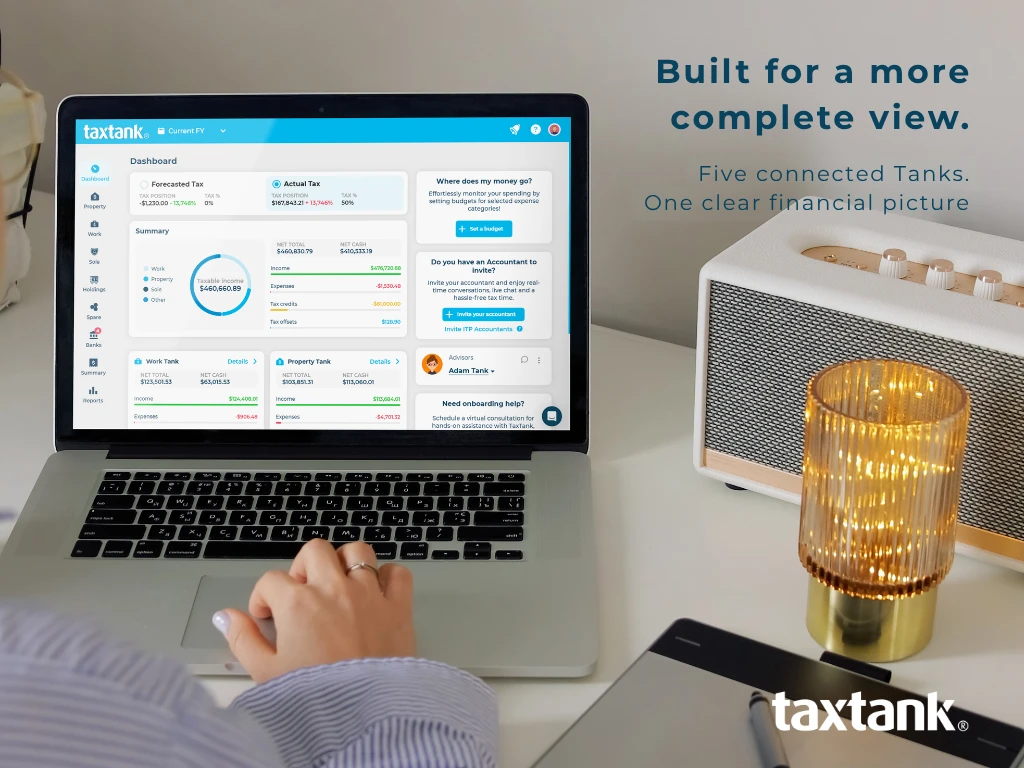
Tax isn’t another box to tick
Financial software comparisons often reduce platforms to a neat list of ticks and crosses.
Property tracking: tick.
Budgeting: tick.
Investment reporting: tick.
Tax-focused: apparently something to be wary of.
But tax isn’t simply another feature to place beside property, investments or budgeting. It is an intelligence layer that changes how all of those areas should be understood.
Leaving tax out doesn’t make financial management simpler.
It leaves part of the outcome unexplained.
By the time a tax return is prepared, most of the decisions affecting it have already been made. The property has been purchased. The loan has been refinanced. The funds have been redrawn. The improvement has been completed. The investment has been sold.
And the supporting records are either safely stored, or hiding in an inbox from four years ago.
A genuinely tax-focused platform helps capture the right information when things happen and preserves that history across financial years.
That doesn’t make it “just tax software.”
It makes it a more complete financial platform.
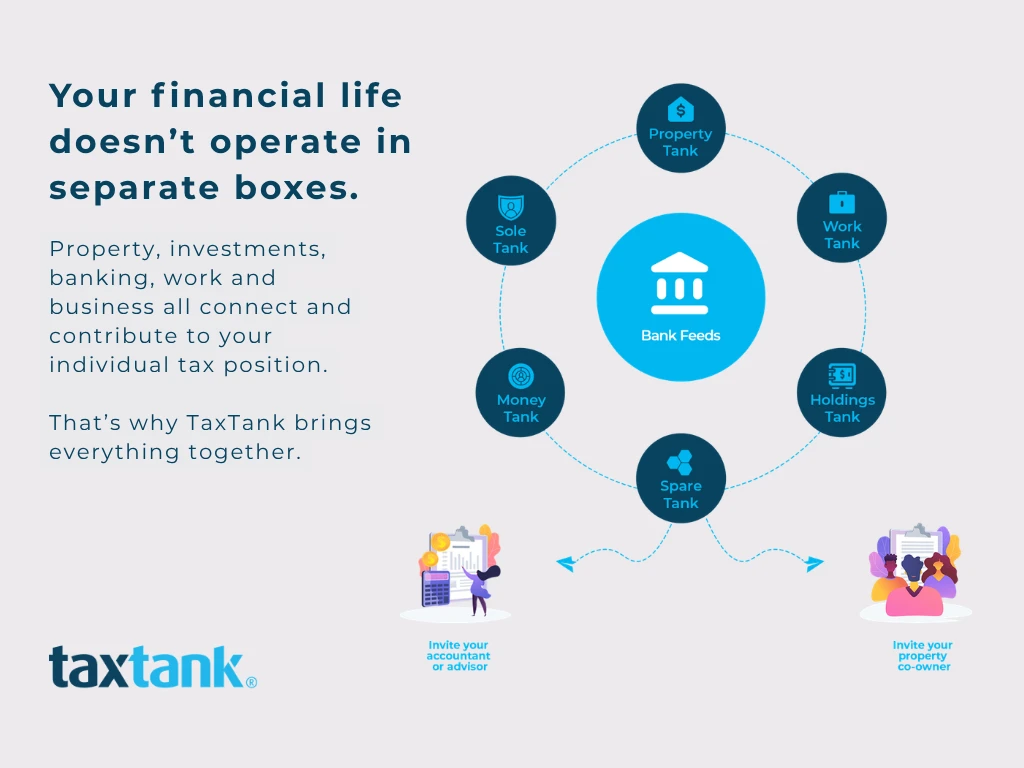
Your financial life doesn’t operate in separate boxes
Your property connects to your loans and bank transactions. Your investments connect to income, capital gains and carried-forward losses. Your work and business activities contribute to your overall tax position.
A decision made in one area can change the outcome in another.
That is why TaxTank was built around the individual and their complete tax return, with dedicated Tanks extending into the different parts of their financial life.
Property Tank brings together property income, expenses, loans, depreciation, equity and performance.
Holdings Tank manages shares, ETFs, cryptocurrency and other investments, together with their income and capital gains tax history.
Work and Sole Tanks help individuals manage employment expenses and business activities, while Money Tank connects personal banking, budgets, goals and everyday financial management.
Each Tank has its own job. Together, they create a connected view of the individual’s tax and financial world.
TaxTank’s tax foundation isn’t a boundary around what the platform can do.
It is what allows TaxTank to go deeper.
Built for what comes next
An AI chat box can be added quickly. Meaningful financial intelligence can’t.
Your financial life deserves more than a quickly built interface, a generic answer or years of personal information pasted into a search box and treated as a one-off question.
It requires purpose-built infrastructure, structured information, connected financial history and a deep understanding of the tax rules that give the numbers meaning.
TaxTank has spent more than seven years building those foundations across property, investments, banking, work, business and tax.
Now, those foundations are about to come to life.
The next generation of TaxTank will bring meaningful AI across the platform, designed to understand the information held securely within your Tanks, follow your financial history as your circumstances and Australian tax laws change, connect the pieces and help you understand what it all means for you.
Because tax isn’t simply another feature.
It is part of almost every financial outcome.
You wouldn’t assess an investment while ignoring its expenses. You wouldn’t assess a loan while ignoring its interest rate.
So why choose financial software that treats tax as an afterthought?
Ready to build something smarter?
Start building the connected tax and financial history that will power what comes next with TaxTank today.
Already an active TaxTank subscriber? Register your interest to help shape the next generation of TaxTank.
Beta registration is open to current paid TaxTank subscribers with no pending cancellation.