

We can send money around the world in seconds, but proving a $79 work expense can still feel like preparing evidence for a royal commission.
Australia has one of the most technologically sophisticated tax administrations in the world.
The ATO receives information from employers, banks, financial institutions, share registries and other third parties.
It has advanced data-matching capabilities, increasingly automated reporting systems and access to enormous amounts of financial information.
Which raises an interesting question.
If tax administration is becoming so sophisticated, why does complying with the system still cost Australians so much?
CPA Australia estimates the annual tax compliance burden at around $60 billion, covering the time and money taxpayers spend on records, reporting and professional advice.
That burden stretches across households and businesses. It isn’t the tax itself. It’s the work required to comply.
I’ve explored that cost in Australia’s $60 billion tax on doing your tax. Here, the question is why better government technology hasn’t made the taxpayer’s job easier too.
And while the ATO’s technology continues to improve, taxpayers are still spending countless hours gathering receipts, categorising expenses, maintaining records and paying professionals to navigate increasingly complicated rules.
Apparently, the future of tax administration has arrived.
Just not equally for everyone.
The ATO knows an extraordinary amount about us
Your employer reports your salary. Banks report interest. Financial institutions supply investment information.
The ATO uses data matching to compare information from third parties with what taxpayers report, helping it identify discrepancies and income that may be missing.
This is a good thing when it improves accuracy, reduces fraud and makes the tax system more efficient.
But knowing that money changed hands isn’t the same as knowing its correct tax treatment.
A transaction doesn’t necessarily explain what an expense was for, whether it was partly private or whether it should be claimed immediately or over several years. Those details still need evidence and, sometimes, professional judgement.
Taxpayers remain responsible for checking the information and supporting their claims.
The opportunity is to make that work easier too. Better technology should help people maintain accurate records throughout the year, alongside helping the ATO find errors afterwards.
Otherwise, one side gets better at asking questions while the other is still looking for the receipt.

The taxpayer is still the unpaid administrator
Consider a typical property investor.
They may need to maintain records of rental income, interest, council rates, insurance, repairs, capital improvements, borrowing costs, depreciation and ownership details.
Then they need to distinguish deductible expenses from capital expenditure, apply the correct rules, retain supporting documentation and ensure everything is reflected accurately in their tax return.
Some of this can be automated.
Some requires professional judgement.
And some exists simply because the legislation itself is complicated.
But when new rules are introduced, the administrative burden generally flows downstream.
From government to accountants.
From accountants to taxpayers.
And eventually to someone’s Sunday afternoon.
The same applies to small business owners who spend hours managing GST, payroll, superannuation, fringe benefits tax and reporting obligations.
They’re not necessarily avoiding tax.
They’re just trying to work out how to comply with it.
And they’re paying for that privilege.
More technology shouldn’t mean more compliance
Here’s where I think we need to be particularly careful.
Sophisticated government technology can make it easier to introduce, monitor and enforce increasingly detailed tax rules.
But that doesn’t necessarily mean those rules are easier for taxpayers to comply with.
Property tax shows why the records matter as much as the calculation.
Investors already need to preserve information about acquisition costs, capital improvements and previous deductions. The ATO’s guidance on CGT records makes clear that relevant records need to be maintained from acquisition, potentially long before an asset is sold.
As tax rules change, the practical question is how taxpayers will maintain the information needed to apply them.
I explore the long-term consequences in Dear ATO, I’ve kept the receipt. Somewhere. Since 2004.
The broader point is simple. If government systems become more efficient while taxpayers are left managing increasingly complicated records, have we reduced the burden, or just moved it?
We need to measure what tax reform actually costs
CPA Australia is calling for a measurable 10 per cent reduction in tax compliance costs by 2030. Against its current estimate, that would mean around $6 billion a year in savings.
It’s a worthwhile objective. But progress needs to be measured from the taxpayer’s side too.
Does a new digital process remove a task, or just move it onto another screen? Does information supplied once get reused, or do people have to enter it again? Does a new rule require records that taxpayers can realistically maintain?
Before introducing new obligations, governments should consider what people will need to do to comply, both immediately and over the years that follow.
Faster processing at the ATO is useful. Fewer hours of unnecessary work for taxpayers would be better still.
The future should be continuous tax records, not annual archaeology
For years, we’ve approached tax as something that happens at the end of the financial year.
Gather the paperwork.
Find the receipts.
Reconcile the accounts.
Work out what was deductible.
And hope nothing important has been forgotten.
But modern financial technology gives us an opportunity to approach things differently.
Bank transactions can be connected and categorised throughout the year.
Supporting documents can be retained alongside the relevant transactions.
Property expenses, depreciation and capital costs can be tracked progressively.
Investment transactions can be recorded as they happen.
And tax calculations can be updated as financial information changes.
Instead of rebuilding the past every July, taxpayers can maintain a much clearer picture of their position throughout the year.
And importantly, preserve the information that may be needed long after the financial year has ended.
Taxpayers deserve better technology too
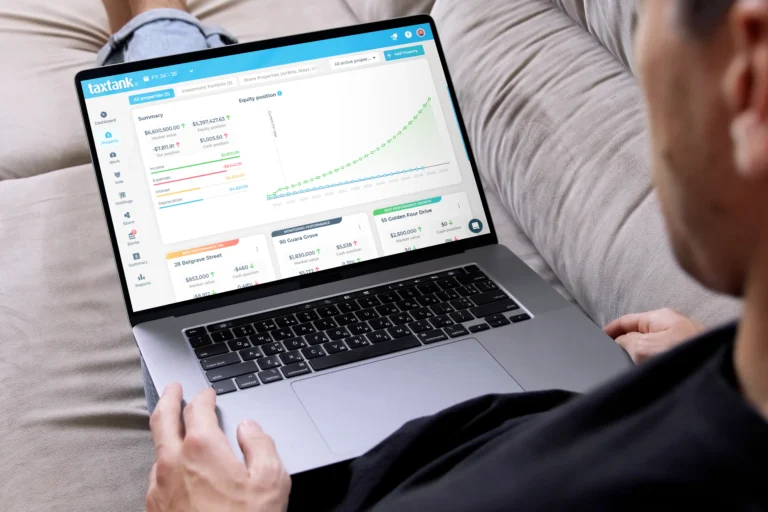
That’s the thinking behind TaxTank.
We’ve brought connected banking, transaction categorisation, tax calculations, property records, investment tracking and supporting documents into one platform, so taxpayers can spend less time gathering information and more time understanding their financial position.
We’re also developing AI capabilities to help identify missing information, explain tax outcomes and reduce the repetitive work that makes compliance so expensive.
Technology won’t fix overly complicated legislation. But it can make complying with it considerably less painful.
The ATO has spent years getting smarter about collecting tax. We think it’s about time taxpayers had smarter tools for managing it.